
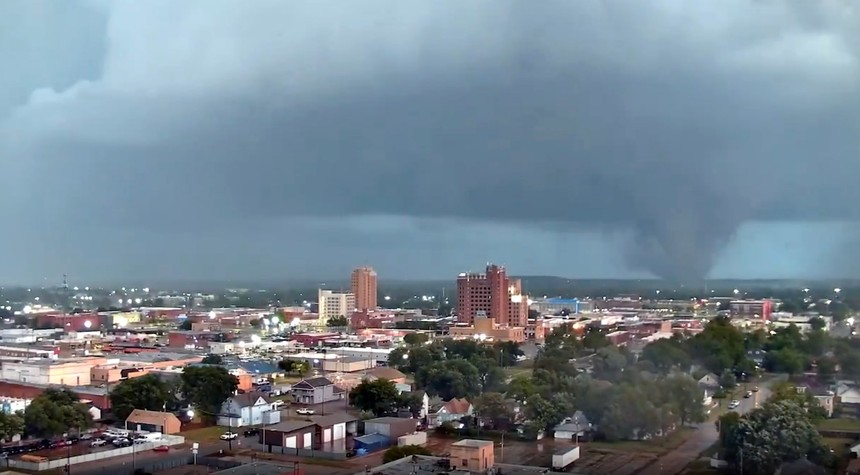
A dangerous and prolonged weather system continues its march across the central United States, placing approximately 27 million Americans in the path of severe thunderstorms and potential tornadoes through the coming days.
The immediate threat has shifted to the southern Plains, where meteorologists have issued watches for severe thunderstorms and possible tornadoes from Kansas southward through Texas. Storm cells began developing Saturday evening, with the greatest tornado risk concentrated across southeastern Oklahoma into northern Texas, including the Dallas metropolitan area, and extending into western Arkansas.
Weather officials have designated a level 4 of 5 “moderate risk” for southeastern Oklahoma and areas across the Red River into Texas. This classification indicates the potential for exceptionally large hail exceeding the size of baseballs, strong tornadoes, and damaging winds. An enhanced risk level of 3 of 5 extends across much of eastern Oklahoma, northern Texas, and into Arkansas, encompassing major population centers including Oklahoma City, Tulsa, and Fort Smith.
The primary threats in these areas include damaging winds and very large hail, though meteorologists warn that strong tornadoes remain possible. Discrete supercell formations are expected throughout the evening hours and will persist overnight.
As one system moves through, another storm is emerging from the Rocky Mountains. This second weather event will sweep northeast across the Plains on Sunday before pushing eastward into the Midwest by Monday.
Sunday’s forecast places an enhanced risk across much of Kansas and portions of western Missouri, including Wichita and Kansas City. Residents in these areas should prepare for the possibility of strong tornadoes, damaging winds, and large hail. A slight risk extends across northern Texas, northwest Arkansas, western Missouri, far southwest Iowa, southern Nebraska, most of Oklahoma, and remaining areas of Kansas.
By Monday, the severe weather threat expands northeast, stretching across the Mississippi Valley into the Midwest. Major cities under enhanced risk include St. Louis, Cedar Rapids, Jonesboro, Evansville, Paducah, and Rockford. Additional communities including Memphis, Louisville, Chicago, South Bend, and Milwaukee face a slight risk designation.
The consistent threats throughout this multi-day event include widespread damaging wind gusts, large hail, strong tornadoes, and spotty flash flooding.
Tuesday will bring the severe weather threat to portions of the South, with Memphis, Little Rock, Tyler, Shreveport, and Jackson all monitoring conditions for potential severe weather later in the day.
Meanwhile, the Southeast faces a compounding crisis as drought conditions continue to worsen. The prolonged dry spell has elevated wildfire risk across the region. Two fires are currently burning in southeast Georgia: the Highway 82 fire in Brantley County and the Pineland Road fire in Clinch County.
Residents across the affected regions are urged to monitor local weather conditions closely and have emergency plans in place as this significant weather pattern unfolds across America’s heartland.
Related: Bronx Parents Demand More Police Protection as Mayor Cuts NYPD Budget
