
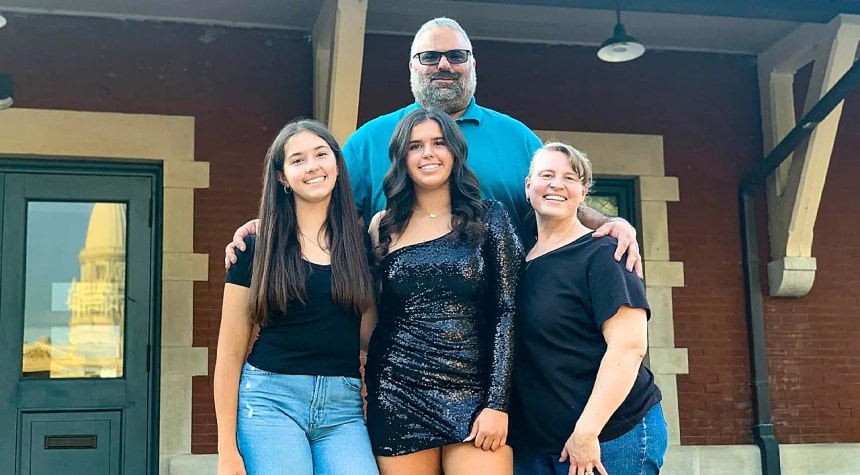
There’s something uniquely American about believing we can prepare for every tragedy, that our systems and protocols will catch the warning signs before it’s too late. Wednesday night in West Lafayette, Indiana, shattered that illusion once again. A courthouse security officer murdered his wife and two teenage daughters before taking his own life, and somewhere in the chaos, one of those girls made a 911 call that should haunt every person who hears about it.
Julie Tkach, 53, was a clinical assistant professor at Purdue University who spent over two decades teaching hospitality management. By all accounts, she was the kind of educator who actually gave a damn about her students. She’d built a career on helping young people find their way in the service industry, mentoring them through the challenges of a demanding field. Her daughters, Katharyn and Lauren, were 17 and 16. They had their whole lives ahead of them.
Their father, Thomas Tkach, 51, worked courthouse security for the Tippecanoe County Sheriff’s Office. Let that sink in for a moment. This man was entrusted with protecting people in one of our most sacred civic spaces. He’d served as a jail deputy before that. These aren’t minor positions. These are jobs that require background checks, psychological evaluations, and ongoing assessments. Someone in authority decided this man was fit to carry a weapon and maintain order.
The dispatcher’s recording tells you everything you need to know about how quickly things went wrong. One of the daughters called for help. She told them her father had a gun and was threatening to shoot the family. Then the dispatcher heard multiple gunshots. The line went silent. By the time officers arrived shortly after 8:30 that evening, it was over. The coroner’s office wasn’t notified until nearly 1:50 in the morning the next day.
You know what frustrates me most about these stories? We always find out afterwards that there were signs. Maybe not public ones, maybe not obvious ones, but signs nonetheless. A man doesn’t just wake up one day and decide to murder his entire family. That darkness builds over time. It festers. And in this case, it festered inside someone who was supposed to protect and serve.
The West Lafayette Police Department called it a "terrible night" that deeply affected its personnel. The sheriff’s office acknowledged that their people saw and heard things they’ll remember for the rest of their lives. That’s the sanitized version of what first responders go through. The reality is probably far worse. Imagine being the dispatcher who heard those gunshots, knowing you were listening to someone die and there wasn’t a thing you could do about it. Imagine being the officer who entered that home.
We talk a lot about mental health these days, and that’s good. The coroner’s office dutifully included information about the 988 Suicide and Crisis Lifeline in their statement. These resources matter. But let’s be honest about something uncomfortable. Thomas Tkach didn’t need a hotline number. His family needed protection from him, and they didn’t get it in time. One of his daughters literally called for help while staring down the barrel of her father’s gun.
Indiana State Police took over the investigation because Thomas worked for the sheriff’s office. That’s standard protocol when law enforcement is involved. It prevents conflicts of interest and maintains public trust. But here’s what protocol doesn’t address: how someone in law enforcement, someone who should understand the gravity of violence better than most civilians, could commit such an unspeakable act against his own children.
Purdue University released a statement offering condolences and support to those affected by Julie’s death. It’s the kind of carefully worded response institutions give when tragedy strikes close to home. They’re mourning a colleague, yes, but they’re also managing a crisis. Students who learned from Julie now have to process the fact that their professor was murdered by her husband. That’s not something you just move past.
This happened in a college town, in a neighborhood where people probably thought they were safe. West Lafayette isn’t some crime-ridden urban center. It’s the kind of place where families put down roots, where professors raise their kids near campus, where life feels manageable and predictable. Except it’s not. Violence doesn’t respect zip codes or education levels or employment status.
The truth is that domestic violence cuts across every demographic we can imagine. It happens in wealthy families and poor ones, in educated households and not, in religious homes and secular ones. The common thread isn’t economics or education. It’s power and control. When someone decides that they’d rather destroy their family than lose control over them, all our assumptions about safety collapse.
What could have changed this outcome? That’s the question investigators will spend months trying to answer, and honestly, I’m not sure we’ll ever know. Maybe there were prior incidents that went unreported. Maybe Julie and her daughters were too afraid to speak up, knowing that their husband and father had law enforcement connections. Maybe they did speak up and nobody listened. All of those scenarios are equally plausible and equally damning.
We owe it to Katharyn and Lauren to ask harder questions about how we prevent these tragedies. Not just with hotlines and awareness campaigns, but with concrete action when warning signs appear. If a man who carries a gun for his job shows signs of instability, we need systems that actually remove that gun before he uses it on his family. That’s not about demonizing law enforcement. It’s about protecting innocent people from domestic terrorism, because that’s what this was.
The dispatcher heard gunshots. Help was coming, but it came too late. That’s going to haunt everyone involved, and it should haunt the rest of us too. Because somewhere right now, another family is living in fear, and another person is contemplating violence, and we’re all just hoping our systems catch it in time. Hope isn’t a strategy. We need to do better.
Related: Trump Signs Bill Ending Penny Production After 232 Years