
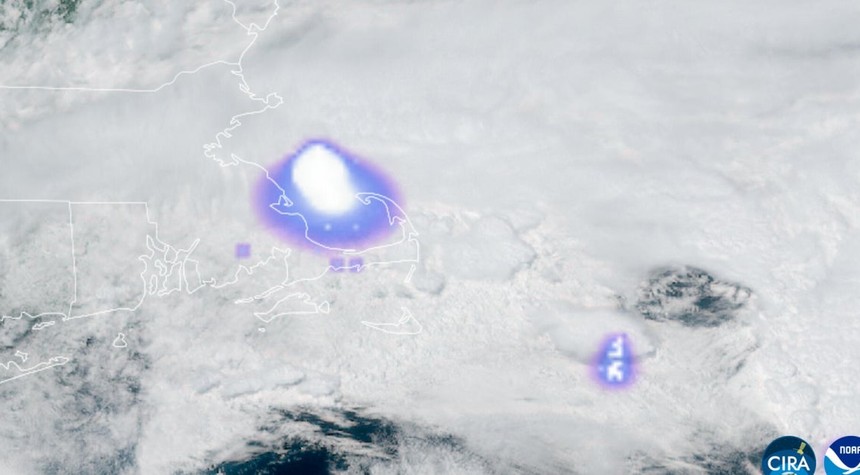
A meteor exploded approximately 40 miles above the Massachusetts coastline Saturday afternoon, releasing energy equivalent to 300 tons of TNT and producing a sonic boom that rattled windows and shook homes across New England.
The National Aeronautics and Space Administration confirmed that the space rock fragmented over northeastern Massachusetts and southeastern New Hampshire at approximately 2:11 p.m. Eastern Time. The explosion’s force created shock waves powerful enough to be heard from Boston to as far south as Johnston, Rhode Island, and north to Ipswich, Massachusetts.
Dozens of eyewitnesses across the Northeast reported seeing a brilliant fireball streaking through the afternoon sky around 2 p.m., according to preliminary reports submitted to the American Meteor Society. The widespread sightings, spanning multiple states, have provided scientists with valuable data to reconstruct the meteor’s trajectory through Earth’s atmosphere.
Satellite lightning detection systems operated by the National Oceanic and Atmospheric Administration recorded a signature consistent with a meteor breakup at the precise time residents reported hearing the mysterious boom. The data indicates the meteor likely entered the atmosphere over the South Shore region near Boston before fragmenting at high altitude.
The phenomenon serves as a reminder that Earth exists in a cosmic shooting gallery, with countless objects entering our atmosphere daily. Most meteors are no larger than pebbles or grains of sand and burn up harmlessly at high altitudes, invisible to observers on the ground. However, larger objects occasionally survive long enough to create the spectacular fireballs and thunderous shock waves that captured attention across New England on Saturday.
The physics behind such events is straightforward but dramatic. Meteors enter Earth’s atmosphere at extraordinary velocities, typically between 25,000 and 160,000 miles per hour. When a larger object plunges deep into the atmosphere, it compresses the air ahead of it with tremendous force, creating pressure waves similar to those produced by supersonic aircraft. These waves can travel dozens of miles from the meteor’s actual path, reaching the ground as sonic booms.
Shauna Edson, an astronomy educator for the Smithsonian National Air and Space Museum, explained that observers hear both the air compression created by the meteor’s tremendous speed and sometimes the sound of the stone itself fragmenting under extreme atmospheric forces.
The U.S. Geological Survey noted an important distinction between meteor-related booms and earthquakes. While earthquakes originate from discrete locations within the Earth, sonic boom events occur along a linear path through the atmosphere, which explains why Saturday’s boom was reported across such a wide geographic area.
As for recovering physical evidence of Saturday’s visitor from space, prospects appear dim. Edson noted that if the meteor fragments landed off the Massachusetts coast as suspected, retrieval would be highly unlikely. The vast majority of meteorites that survive atmospheric entry land in Earth’s oceans, which cover more than 70 percent of the planet’s surface.
Nevertheless, the eyewitness accounts and any video footage of the fireball will prove valuable to scientists working to understand these celestial visitors and their interactions with our atmosphere.
Related: Ohio Woman Wins Year of Free Burgers in Wendy’s Look-Alike Contest
