
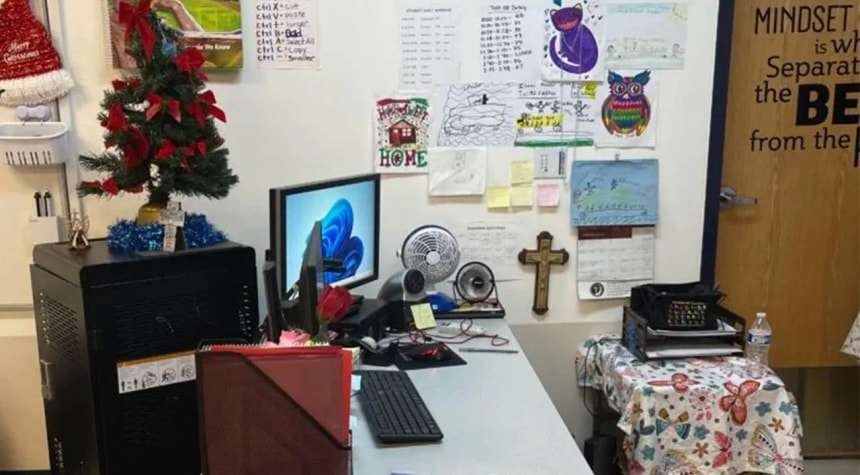
A Connecticut public school teacher with more than three decades of experience will present her case before a federal appeals court this month, arguing that her First Amendment rights were violated when she was removed from the classroom for displaying a crucifix near her desk.
Marisol Arroyo-Castro faces the U.S. Court of Appeals for the Second Circuit on December 7th, seeking to overturn a lower court decision that sided with the Consolidated School District of New Britain. The case has become another flashpoint in the ongoing national debate over religious expression in public institutions.
The facts of the case are these: In December 2024, administrators at DiLoreto Elementary and Middle School ordered Arroyo-Castro to remove a crucifix she had displayed near her desk for approximately ten years. The middle-school social studies teacher refused, telling administrators she could not comply with their directive. She was subsequently escorted from the school, placed on suspension without pay, and eventually reassigned to a non-teaching position away from students.
Arroyo-Castro described the crucifix as a personal source of comfort during her long career, something she would look at while grading papers or completing administrative work. She maintains the display was a private expression of faith, not an attempt to proselytize students. When pressed by administrators to remove it, she said the emotional toll was immediate and severe.
The school district issued a formal reprimand for insubordination on December 11th, removed the crucifix the following day, and placed her on paid administrative leave shortly thereafter. By March 2025, she had been moved entirely out of her teaching role.
Her legal team, led by First Liberty Institute senior counsel Becky Rees Dummermuth, filed a federal lawsuit in January 2025 alleging violations of both the Free Exercise and Free Speech Clauses of the First Amendment. A federal district court judge denied a preliminary injunction in November 2025, determining that the classroom display constituted government speech rather than private expression, and therefore was not protected.
The appeal hinges significantly on the Supreme Court’s recent Kennedy decision, in which football coach Joe Kennedy won the right to pray publicly without fear of retribution from his employer. Arroyo-Castro’s attorneys argue that precedent clearly protects a teacher’s private religious expression, even when students may observe it. They further contend that if teachers are permitted to display personal items at their desks, religious symbols cannot be singled out for prohibition without violating constitutional protections.
The school district has offered a different account. In a statement, a district spokesperson said the matter extends beyond the mere presence of a religious symbol, referencing a third-party investigative report that examined broader concerns about statements and actions affecting students of different religious backgrounds. The district maintains it offered Arroyo-Castro various accommodations that would have allowed her to practice her faith without what they characterized as encroachment on students’ religious freedoms. She declined all proposed alternatives.
The district emphasized its legal and ethical responsibility to maintain inclusive classrooms where students of all faiths feel respected and valued. They assert their position is grounded in principles of neutrality and equal treatment.
The investigative report cited by the district included interviews with four teachers, school administrators, Arroyo-Castro herself, and referenced student claims regarding classroom references to God, Jesus, and religion that exceeded what the investigator considered appropriate for a public school setting.
This case arrives at a moment when courts across the nation are grappling with where to draw lines between individual religious expression and institutional neutrality in public schools. The outcome in the Second Circuit could have implications well beyond one teacher’s crucifix in Connecticut.
For Arroyo-Castro, who devoted more than thirty years to educating young people, the personal cost has been substantial. She remains barred from student contact and removed from the classroom she once called her professional home. Whether the appeals court will restore her to that position, or affirm the district court’s determination that her display crossed constitutional boundaries, will be decided in the coming months.
The oral arguments on December 7th in New York City represent her next opportunity to make her case that a teacher’s private faith, quietly displayed, deserves protection under the Constitution.
Related: John Allen Rubio Executed Nearly 23 Years After Killing Three Children
