
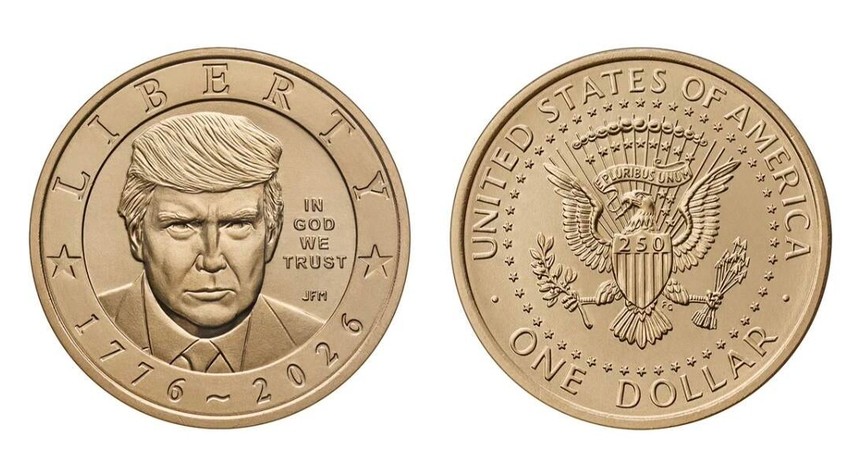
The United States Mint has begun production of a new one-dollar gold commemorative coin bearing the likeness of President Donald Trump, Treasury Secretary Scott Bessent announced this week. The coin represents the latest effort by the current administration to commemorate the nation’s upcoming 250th anniversary while raising questions about the application of long-standing federal currency laws.
Secretary Bessent characterized the coin as honoring “the enduring legacy of liberty and a lasting symbol of patriotism.” He further stated that the piece, featuring President Trump, “celebrates the strength of American values, and the promise of a nation dedicated to preserving freedom for all.”
According to Treasury Department officials, the coin is already in production and will become available to the public beginning this fall. The piece will be composed of non-precious metals with a gold-like finish, rather than actual gold content.
The announcement comes three months after the Treasury Department indicated it was exploring the possibility of issuing a $250 bill featuring Mr. Trump. That proposal, however, would require congressional action to change existing federal statute.
The relevant section of United States Code is unambiguous on this matter. “Only the portrait of a deceased individual may appear on United States currency and securities,” the law states. “The name of the individual shall be inscribed below the portrait.” This prohibition applies to all U.S. currency, which must also bear the inscription “In God We Trust.”
Secretary Bessent acknowledged this restriction during a press briefing in May, explaining that no living person may appear on U.S. currency unless proposed legislation passes Congress and receives presidential approval.
The Trump administration’s position appears to rest on a distinction between currency and commemorative coins. Federal law requires that the bipartisan Citizens Coinage Advisory Committee review and approve proposed commemorative coin designs. The administration has argued that the president may lawfully appear on such a commemorative piece under existing statutory authority.
This interpretation marks a significant departure from traditional practice. While commemorative coins have featured living presidents on rare occasions, the practice has been uncommon and typically reserved for specific congressional authorizations.
The semiquincentennial celebration of American independence provides the stated rationale for this initiative. The 250th anniversary of the Declaration of Independence in 2026 has prompted various federal agencies to develop commemorative programs and products.
The decision to feature a sitting president on commemorative currency nonetheless represents a notable expansion of executive influence over federal symbols and institutions. Critics may argue that such moves blur the line between national commemoration and political legacy-building.
The Treasury Department has not disclosed the expected mintage numbers for the commemorative coin or its anticipated retail price. Standard commemorative coins typically carry premiums above their face value to cover production costs and contribute to designated funds.
As fall approaches, the American public will have the opportunity to purchase these coins and render their own judgment on this latest chapter in the ongoing debate over presidential commemoration and the proper role of living figures on the nation’s currency and coinage.
Related: United States to End Military Mission in Iraq by September 30
