
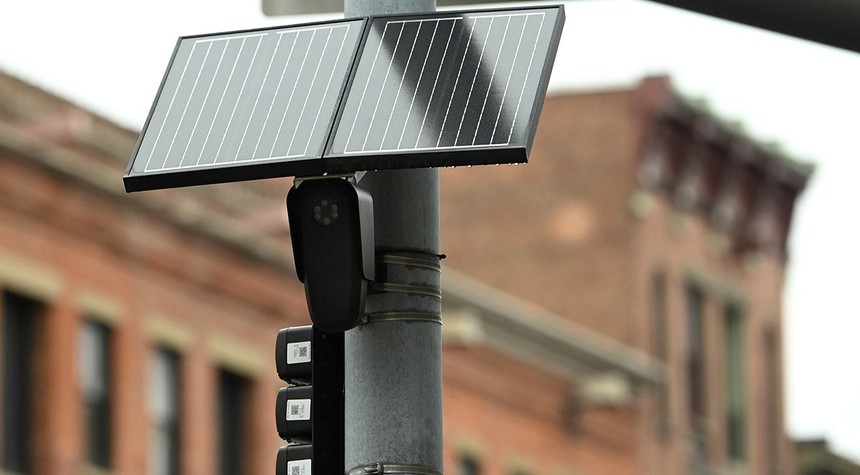
A vast network of surveillance cameras has been quietly deployed across American communities, creating searchable databases that track the movements of tens of millions of drivers each day without warrant requirements.
Automated license plate readers, known as ALPRs, have become one of the most widespread surveillance tools in the nation. These small, solar-powered cameras, typically mounted on poles, buildings, or police vehicles, photograph every passing car and record detailed information about each vehicle.
The technology has expanded rapidly. The American Civil Liberties Union estimates that between 80,000 and 100,000 cameras from Flock Safety, one of the leading vendors in this field, are currently deployed nationwide. The company reports its presence in more than 6,000 communities, partnerships with more than 1,000 businesses, and contracts with more than 5,000 law enforcement agencies. These cameras conduct billions of vehicle scans each month.
The system captures far more than license plate numbers. Each photograph records the vehicle’s make, model, and color, along with distinguishing features such as roof racks, bumper stickers, and scratches. Flock Safety refers to this compilation as a “vehicle fingerprint.” This information is uploaded to searchable databases that can be shared across agencies when the owning department enables such sharing, typically without requiring a warrant.
The constitutional implications have begun drawing scrutiny. Privacy advocates argue that while a single photograph may seem innocuous, the aggregate data presents a different matter entirely. A dense, searchable archive that crosses jurisdictional boundaries can reconstruct an individual’s movements, associations, and daily routines over extended periods, effectively creating what legal scholars call a “mosaic” of a person’s life.
The Electronic Frontier Foundation, after reviewing Flock audit logs, reported finding searches connected to protest activity. Additional concerns have emerged from reported instances of misuse, including allegations that officers conducted searches to track romantic partners or personal acquaintances. More troubling still are cases in which drivers were stopped and held at gunpoint following inaccurate plate scans. One Colorado woman faced accusations of porch theft after police relied on surveillance technology, including Flock cameras, that incorrectly linked her vehicle to a crime scene.
Recent court decisions have upheld specific ALPR networks under review, but judges have left open the question of whether a denser, more revealing system might cross constitutional boundaries. This distinction matters. The question is not whether the technology exists or whether it can be useful to law enforcement, but rather at what point its pervasiveness infringes upon the reasonable expectation of privacy that Americans have traditionally enjoyed.
The debate reflects a broader tension in American society between public safety and civil liberties. As these surveillance networks expand and their capabilities grow more sophisticated, the nation faces fundamental questions about the proper balance between security and freedom. These are questions that deserve serious consideration and robust public debate before the technology becomes so entrenched that meaningful reform becomes difficult.
The matter requires attention now, while policy choices remain available.
Related: California Hiker Found Dead in Big Sur Died from Alcohol Withdrawal Complications
