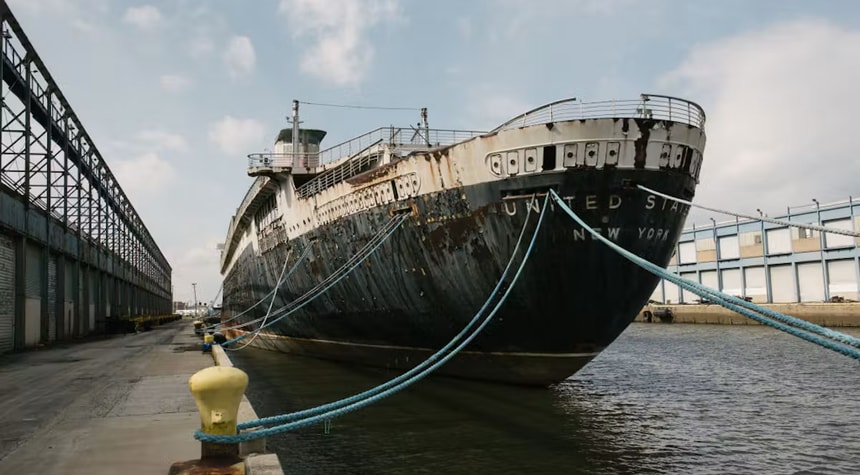
The SS United States, once the fastest ocean liner ever constructed and a symbol of American maritime supremacy in the postwar era, settled to the ocean floor Wednesday evening approximately 22 nautical miles southwest of Destin, Florida.
The 990-foot vessel disappeared beneath the waves at 8:59 p.m. Central Time following a controlled sinking operation that began earlier in the day. Crews had spent hours flooding the hull through specially cut openings before the ship made its final descent. Sonar imaging confirmed the liner came to rest upright in roughly 180 feet of water, nearly precisely where planners had intended.
County officials announced Thursday that the wreck site is now accessible to divers, though local diving professionals have cautioned that conditions around the newly submerged vessel will require time to stabilize. Escaping air pockets and equipment dislodged during impact with the sea floor may present hazards in the immediate aftermath of the sinking.
The ship now serves as the centerpiece of Okaloosa County’s artificial reef program. Tourism officials expect the wreck to become a significant attraction for recreational divers visiting the region. Preparation crews removed hazardous materials, drained fuel tanks, stripped wiring and other potential entanglement risks, and cut passages throughout the interior to provide divers with safe routes to open water.
Naval architect William Francis Gibbs designed the SS United States, which was launched in 1951 during the early years of the Cold War. The vessel was engineered to serve dual purposes: a luxury passenger liner in peacetime and a rapid troop transport should military necessity arise.
In July 1952, the ship captured the Blue Riband on its maiden voyage by breaking transatlantic speed records in both eastbound and westbound crossings. That distinction, awarded to the fastest passenger vessel on the Atlantic route, remains unclaimed by any other ocean liner to this day.
For nearly two decades, the SS United States transported passengers between American and European ports. Its passenger manifest read like a catalog of mid-century prominence. Grace Kelly, Elizabeth Taylor, Marilyn Monroe, Walt Disney, and Duke Ellington all crossed the Atlantic aboard the vessel. In 1963, Leonardo da Vinci’s Mona Lisa made the westward journey on the ship during its celebrated visit to the United States.
The advent of commercial jet aviation fundamentally altered transatlantic travel economics. By 1969, the SS United States could no longer operate profitably and was withdrawn from service. The ship spent subsequent decades berthed in Philadelphia while various proposals to convert it into a hotel, museum, or entertainment venue failed to secure necessary funding.
The vessel’s fate grew uncertain after its eviction from the Philadelphia berth in 2024. The SS United States Conservancy, which had worked for years to preserve the liner, ultimately negotiated its sale to Okaloosa County for one million dollars. The alternative was scrapping.
The ship was towed to Mobile, Alabama, in 2025 for extensive preparation work. Its distinctive red, white, and blue smokestacks were removed for installation in a planned museum and visitor center in the Destin area.
Susan Gibbs, granddaughter of the ship’s designer and director of the SS United States Conservancy, acknowledged the emotional complexity of watching the vessel sink. She has characterized the decision as a mixture of sorrow and gratitude, but maintains that transformation into an artificial reef offered a more honorable conclusion than the scrapyard.
That the SS United States now rests on the ocean floor represents both an ending and a continuation. The ship that once raced across the Atlantic surface now lies beneath those same waters, its purpose transformed but its service to the public not yet concluded.
Related: Questions Mount as New York Mayor Prepares to Dismantle Key Police Response Unit