
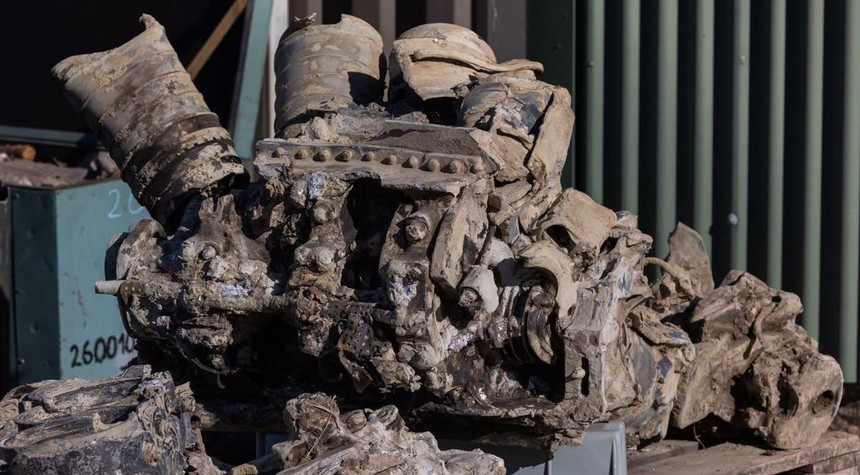
Excavators in central Hungary have recovered the wreckage of a Soviet fighter aircraft that crashed during World War II, along with personal items belonging to its pilot, marking a significant archaeological discovery nearly eight decades after the wartime encounter.
The Hungarian Museum of Military History announced that researchers unearthed the Soviet Yakovlev Yak-1 fighter aircraft approximately 17 feet beneath the surface in Törtel, a village situated roughly 50 miles southeast of Budapest. The excavation, which commenced in September under the direction of István Kocsis, a member of the research association leading the investigation, has yielded remarkably preserved artifacts from the November 1944 incident.
Museum officials report that several sections of the aircraft emerged from the crash site in relatively intact condition. Among the recovered pieces was a portion of the red star insignia, the distinctive marking printed on all Soviet military equipment during that period. Despite its extended burial, the insignia remains in what officials described as relatively good condition.
Archaeologists also recovered a section of the aircraft’s fuselage bearing the jet’s side identification number. The discovery extends beyond mere mechanical components, however. Personal belongings of the pilot surfaced during the excavation, including a book containing the pilot’s signature. Museum experts have undertaken the delicate task of restoring this item, which may provide valuable insights into the individual who flew the aircraft.
Historical records have enabled researchers to connect this wreckage to a specific aerial engagement that occurred over Törtel in November 1944. The incident involved German Lieutenant Peter Düttmann and Soviet Lieutenant Alexander Semyonovich Andrianov in an aerial duel that concluded with Düttmann shooting down the Soviet fighter.
Lieutenant Andrianov successfully escaped the damaged aircraft by parachute but subsequently became a prisoner of war, according to historical accounts. This detail adds a human dimension to what might otherwise remain simply an archaeological curiosity.
The museum has indicated that the most well-preserved pieces from the wreckage will eventually be placed on public exhibition. However, this display awaits completion of restoration procedures and the comprehensive documentation process currently being conducted by the museum’s archaeology department.
This discovery represents more than a historical footnote. It serves as a tangible connection to the complex and often overlooked Eastern European theater of World War II, where Soviet and German forces engaged in extensive combat operations. The preservation of personal effects alongside military hardware provides researchers with an uncommon opportunity to examine both the technological and human aspects of aerial warfare during this period.
The ongoing restoration and research efforts may yet reveal additional details about this particular aircraft, its mission on that November day in 1944, and the ultimate fate of Lieutenant Andrianov following his capture. Such discoveries remind us that history, even after eight decades, continues to yield its secrets from beneath the earth where the events of war once unfolded.
Related: Federal Task Force Identifies Additional $40 Million in Welfare Fraud