
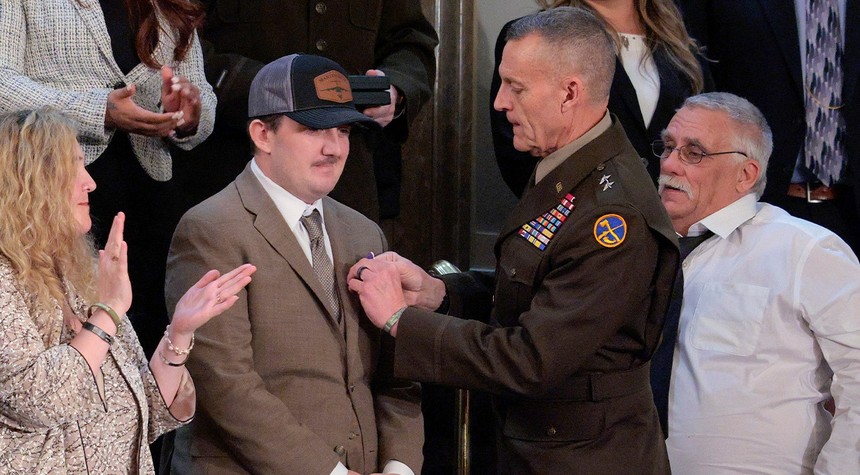
President Donald Trump’s State of the Union address this week produced a rare moment of bipartisan unity when he honored two National Guard members wounded in what federal authorities are investigating as a terrorist attack near the nation’s capital.
According to focus group data measuring real-time voter reactions, Democrats, Republicans, and Independents all responded positively when the President awarded the Purple Heart to Staff Sergeant Andrew Wolfe and posthumously honored Army Specialist Sarah Beckstrom during his address to the nation.
The dial test, administered by Lee Carter, president of maslansky+partners, tracked voter sentiment throughout the speech using electronic dials that participants turned to indicate their approval or disapproval of specific moments. The ceremony honoring the two service members registered as one of the few segments that garnered favorable responses across all three political affiliations.
Staff Sergeant Wolfe, 24, and Specialist Beckstrom, 20, were both shot by a gunman just blocks from the White House last November. Beckstrom succumbed to her injuries, while Wolfe survived the attack. Federal authorities continue to investigate the incident as a potential act of terrorism.
The alleged shooter is an Afghan refugee who entered the United States as part of Operation Allies Welcome, the program established during the military withdrawal from Kabul in 2021. The program facilitated the evacuation and resettlement of Afghan nationals who had assisted American forces during the two-decade conflict.
The Purple Heart, one of the nation’s oldest military decorations, is awarded to members of the armed forces who are wounded or killed in action against an enemy of the United States. President Trump presented the medal to Wolfe in person and delivered one to Beckstrom’s family in recognition of her service and sacrifice.
While much of the State of the Union address received divided reactions along partisan lines, this particular moment stood apart. The focus group data suggests that honoring military service and sacrifice remains one of the few areas where Americans of differing political persuasions find common ground.
The bipartisan response to this segment of the address reflects a broader pattern in American political life. Regardless of disagreements on policy matters, support for individual service members and recognition of their sacrifices tends to transcend partisan divisions.
The incident last November raised questions about security protocols in the nation’s capital and the vetting procedures for refugees entering the country through emergency programs. Those policy debates continue in Congress, but the focus during the State of the Union remained squarely on honoring the two young Americans who were wounded while serving their country.
The positive reception across party lines to this portion of the President’s address offers a reminder that shared values still exist in an increasingly polarized political environment. Whether such moments of unity can translate into broader cooperation on substantive policy matters remains to be seen.
Related: President Challenges Congress on Immigration Priorities as Democrats Remain Seated
