
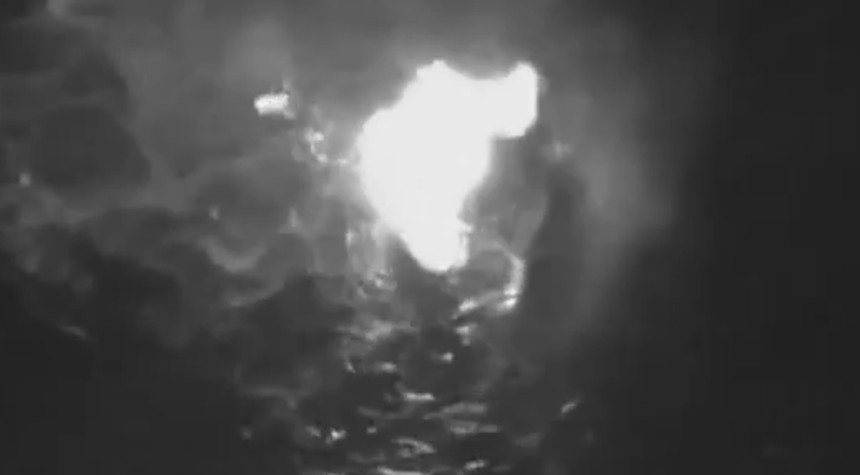
The United States military conducted its fourth strike against a suspected drug trafficking vessel in the eastern Pacific Ocean on Tuesday, resulting in four additional fatalities and bringing the total death toll from these operations to 175 since early September.
U.S. Southern Command released aerial footage showing the targeted vessel moments before a projectile struck it, causing the boat to explode. The military has now announced strikes on four separate vessels over the past four days, with two boats struck on Saturday, one on Monday, and the latest on Tuesday.
According to official statements, all targeted vessels were operated by designated terrorist organizations and were transiting along known narco-trafficking routes in the eastern Pacific while engaged in drug trafficking operations. However, military officials have not provided public evidence to support these determinations.
When questioned about the specifics of Monday’s strike, which killed two individuals, a spokesperson for U.S. Southern Command declined to elaborate, citing operational security concerns. The spokesperson stated that the command cannot discuss specific sources or methods used to identify and target these vessels.
The operations have resulted in survivors in at least six instances, prompting search and rescue efforts in most cases. The U.S. Coast Guard suspended its search on Tuesday for one survivor from Saturday’s attack. While authorities have called off several of these searches, one October operation successfully recovered two survivors, who were subsequently repatriated to Ecuador and Colombia via Navy helicopter.
The campaign’s inaugural strike on September 2 resulted in a particularly troubling outcome. Two individuals survived the initial attack but were killed in what appears to have been a follow-up strike, though complete details of that incident remain unclear.
The escalating death toll and the frequency of these strikes raise significant questions about the rules of engagement governing these operations. The military’s classification of the targeted vessels as being operated by designated terrorist organizations provides legal justification under current counterterrorism authorities, yet the lack of publicly available evidence supporting these designations has drawn scrutiny.
These maritime interdiction operations represent a notably aggressive approach to combating drug trafficking in international waters. The eastern Pacific has long served as a primary corridor for narcotics flowing from South American production centers toward markets in Central America, Mexico, and ultimately the United States.
The military’s reluctance to discuss operational methods is standard practice in sensitive operations, yet the mounting casualties and the instances of survivors being left at sea have prompted questions about proportionality and the humanitarian aspects of these engagements.
As this campaign continues into its third month, the American public deserves a fuller accounting of the legal framework, targeting criteria, and rules of engagement governing these deadly strikes. The fight against narco-terrorism is unquestionably important to national security, but it must be conducted with transparency sufficient to maintain public trust and ensure accountability.
The facts, as they stand, present a clear picture of an intensive military campaign with significant human costs. What remains less clear is the complete strategic rationale and the safeguards in place to prevent errors in targeting.
Related: Family’s Utah Hiking Trip Becomes Emergency Rescue After Cliff Fall Near Moab
