
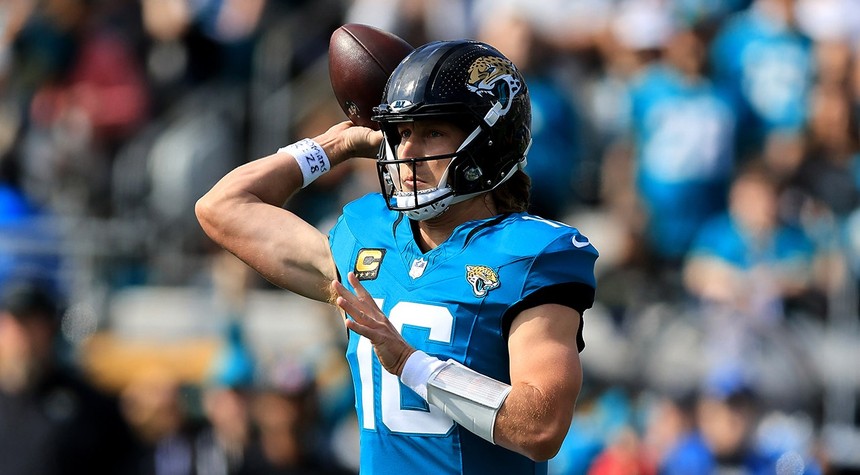
The Jacksonville Jaguars delivered a commanding performance Sunday afternoon, defeating the New England Patriots by a score of 35 to 6. Yet in a game that showcased the team’s considerable strengths, one peculiar moment has generated substantial discussion among observers of professional football.
Trevor Lawrence, the Jaguars’ talented young quarterback, threw three touchdown passes in the convincing victory. The win maintains Jacksonville’s position atop the AFC South division with a 3-0 record, continuing the momentum from last season’s impressive 13-4 campaign, their finest showing since 1999.
The Patriots offered little resistance offensively, managing only two field goals throughout the contest. Jacksonville appeared to have complete control from start to finish, which makes what transpired late in the fourth quarter all the more perplexing.
With the Jaguars holding a comfortable 28-6 advantage and fewer than nine minutes remaining, Lawrence took a designed quarterback run on third down and three yards to gain. The play developed precisely as drawn, and Lawrence broke into open field with a clear path to the end zone. What happened next defies conventional football wisdom.
Rather than crossing the goal line for what would have been a 35-6 lead, Lawrence deliberately slid to the turf at the one-yard line, forgoing the certain touchdown.
The decision warrants examination. Those who favor conservative game management might argue Lawrence sought to preserve clock, keeping possession and forcing New England to exhaust their remaining timeouts. However, the mathematics of the situation suggest otherwise. A touchdown at that juncture would have created a 35-6 advantage, requiring the Patriots to score four times in approximately eight minutes merely to force overtime, assuming successful two-point conversions along the way.
Given New England’s offensive struggles throughout the afternoon, such a comeback scenario bordered on the impossible. The Patriots had demonstrated no capacity to move the football with any efficiency. A four-score deficit would have rendered the outcome beyond any reasonable doubt.
The Jaguars organization has built something substantial in recent seasons. The combination of head coach and quarterback has proven formidable, and the team’s performance through three games suggests they remain legitimate contenders in the conference. This single play does not diminish those accomplishments.
Nevertheless, the incident raises questions about decision-making in moments when games appear decided. Professional football demands that players maximize every opportunity, both for team success and individual performance. Whether Lawrence acted on instruction from the sideline or made the choice independently remains unclear.
For those who wagered on the game or manage fantasy football rosters, the decision proved costly and frustrating. While such considerations exist outside the realm of pure competition, they represent real interests for millions who follow the sport closely.
The Jaguars secured the victory regardless, and Jacksonville supporters have ample reason for optimism as the season progresses. Yet in a league where every statistical advantage and momentum shift carries weight, choosing not to score when the opportunity presents itself will always invite scrutiny.
That is the way it is.
Related: Senator Fetterman Mistakenly Calls Himself Lifelong Republican at Texas Festival
