
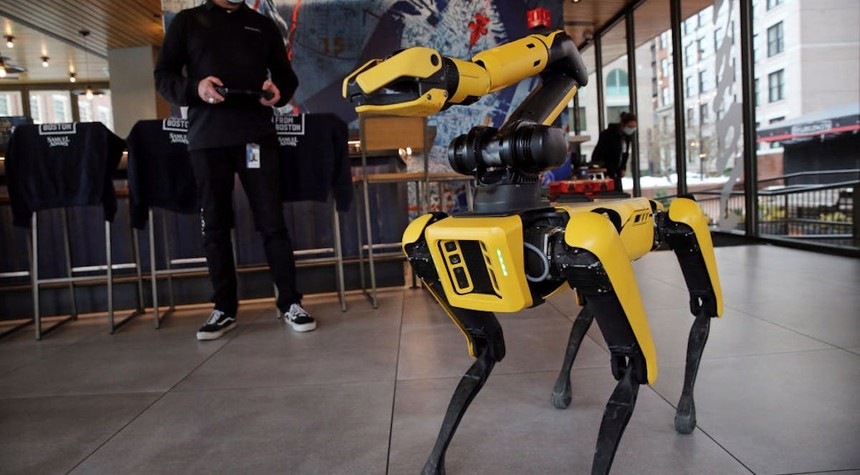
The United States Immigration and Customs Enforcement agency has announced plans to acquire robotic dogs manufactured by Boston Dynamics at a cost of up to two million dollars, marking another significant technological investment as the Trump administration continues its expansive immigration enforcement operations.
According to a Department of Homeland Security funding document released Thursday, ICE may spend between one and two million dollars on the company’s “Spot” robotic units and associated equipment. This procurement represents the latest in a series of technological acquisitions aimed at enhancing agent capabilities in the field.
The timing is notable. Just weeks ago, the Department of Homeland Security authorized up to twenty million dollars for ICE to purchase electric shock gloves, which agents would employ to subdue combative individuals during enforcement operations. The rapid succession of these purchases underscores the administration’s commitment to equipping its immigration enforcement personnel with advanced tools.
A senior official within the Department of Homeland Security has clarified that these robotic units will not be deployed to conduct arrests. Rather, according to ICE’s procurement documentation, the machines are intended to provide agents with remotely operated capabilities for inspection, situational awareness, and hazard assessment in environments that present significant risks to human personnel.
The official notice states that this capability improves officer safety, supports informed operational decision-making, and enhances the department’s ability to respond to incidents involving dangerous, confined, unstable, or difficult-to-access areas.
Boston Dynamics’ Spot robots come equipped with cameras and sophisticated sensors capable of detecting various hazards including gas leaks, radiation, and vibrations. These machines possess the ability to navigate challenging terrain and, depending on their configuration, can employ an extendable arm to interact with physical objects in their environment.
This technology is not unprecedented in law enforcement circles. Police departments in major American cities including Los Angeles and New York have already incorporated this technology into various operations. The United States Secret Service deployed Spot robots to assist in securing President Trump’s Mar-a-Lago residence in Florida during 2024.
Boston Dynamics maintains that its robots are not designed to function as weapons. The company’s stated ethics policy explicitly prohibits authorization or partnership with customers seeking to use its robots as weapons or autonomous targeting systems.
The increased investment in technology corresponds with a documented rise in violence directed at ICE personnel. The Department of Homeland Security reports that assaults against ICE agents have increased by thirteen hundred percent, while vehicular attacks have risen by thirty-three hundred percent during the current administration’s intensified deportation efforts.
These robotic units could provide agents with enhanced security by enabling them to inspect potentially dangerous locations without immediately exposing human officers to harm. The procurement document does not establish a definitive timeline for deployment, and the government’s market research process does not guarantee that ICE will ultimately complete the purchase.
However, should the acquisition proceed as planned, ICE agents may soon possess a considerably expanded arsenal of specialized technology designed to help them assess dangerous situations, protect themselves, and execute the Trump administration’s immigration enforcement objectives.
The American people deserve assurance that their law enforcement agencies possess the tools necessary to carry out their duties safely and effectively. Whether this particular technological investment proves wise remains to be seen as the procurement process continues forward.
Related: Federal Mandate Slashes Arizona’s Colorado River Access by 30 Percent
