
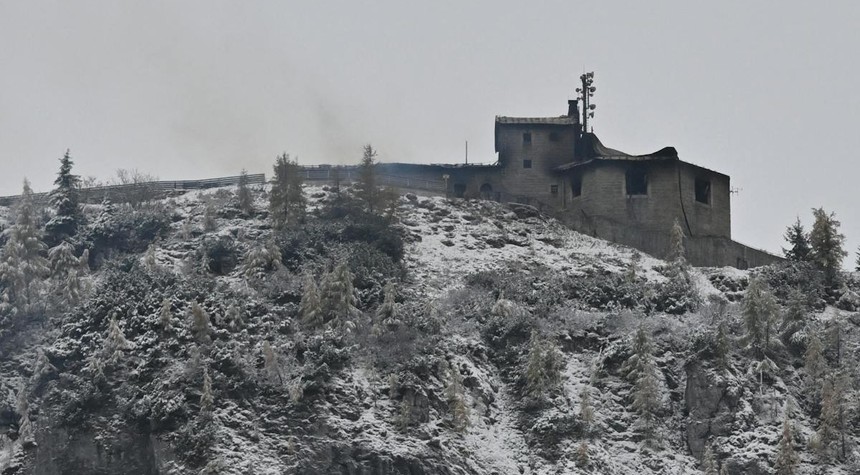
A fire of suspicious origin has destroyed the Kehlsteinhaus, the Alpine structure built for Adolf Hitler that has served as a mountain restaurant for seven decades. German authorities arrested a 33-year-old man in connection with the blaze that reduced the historic building to ruins late Friday evening.
Emergency services received reports of the fire at approximately 9:15 p.m. local time in southeastern Bavaria. The response was substantial: nearly 200 firefighters, police officers, and rescue personnel ascended the mountain above Berchtesgaden to combat the flames. Upon arrival, crews found the entire structure engulfed in fire. Fortunately, the building was unoccupied at the time, and no injuries were reported.
Police apprehended a motorcyclist traveling down the steep access road as emergency crews made their way to the scene. German authorities report the suspect attempted to flee on his motorcycle before officers stopped him. The man, a German national with connections to the region, now faces arson charges.
Prosecutors in Traunstein announced Saturday that preliminary psychiatric evaluation suggests the suspect suffers from mental illness. An investigating judge in Rosenheim reviewed the case, and prosecutor Rainer Vietze indicated authorities will seek the man’s commitment to a secure forensic psychiatric facility. Vietze noted that investigators must operate under the assumption that the suspect’s criminal responsibility was diminished, though officials emphasized they will still investigate whether political motivations played any role in the incident.
Firefighting efforts faced significant challenges from adverse weather conditions. Wind and the season’s first snowfall complicated operations at the 6,017-foot elevation site, forcing crews to withdraw temporarily during the night. The risk of falling debris prevented firefighters from entering the structure on Saturday. Early damage assessments place losses in the millions.
Bavarian Interior Minister Joachim Herrmann, whose state government holds ownership of the building, confirmed adequate insurance coverage and signaled the government’s intention to rebuild. Speaking at a party convention in Munich, Herrmann stated plainly that leaving ruins on the site would not be acceptable.
The structure itself carries complex historical significance. Nazi official Martin Bormann commissioned the chalet’s construction in 1937, and it was formally presented to Hitler on his fiftieth birthday in April 1939. Historical records indicate Hitler, reportedly uncomfortable with heights, visited the location only approximately fourteen times during the Nazi era.
The building survived an Allied bombing raid on the Obersalzberg in April 1945 with relatively minor damage. Since 1952, it has operated as a mountain restaurant, with visitors accessing the site via bus and an elevator carved through the mountainside rock.
The Obersalzberg Documentation Center, the region’s primary museum dedicated to documenting Nazi history, is located farther down the mountain and sustained no damage from the fire. That facility continues its educational mission, providing historical context for the area’s role during Germany’s darkest chapter.
The investigation into the fire continues as German authorities work to determine the full circumstances surrounding this significant loss of a historically important, if troubling, landmark.