
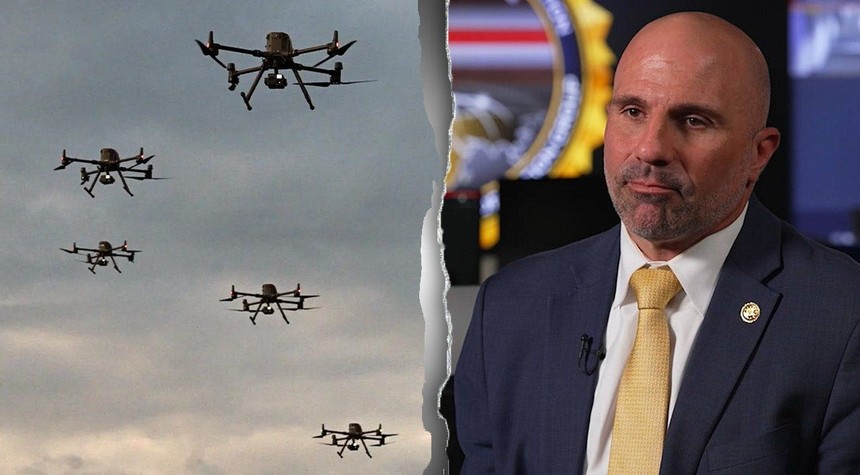
The Federal Bureau of Investigation has issued a stark warning about what officials describe as an inevitable threat to American security: the arrival of battlefield-style drone attacks on United States soil.
FBI Deputy Director Chris Raia stated in a recent interview that it is “only a matter of time” before the type of drone warfare currently witnessed in overseas conflicts manifests within American borders. The assessment comes as federal investigators work urgently to prepare for rapidly evolving technology that could enable operators thousands of miles away to pilot aircraft targeting Americans.
“I think the biggest threat right now, kind of the five-yard target, if you will, is going to be that threat from a drone,” Raia explained. He emphasized that his primary concern centers not on large-scale coordinated attacks reminiscent of September 11th, but rather on the threat posed by lone actors or small groups now equipped with capabilities once reserved for sophisticated military operations.
The warning reflects a fundamental shift in the security landscape. Federal officials have grown increasingly alarmed that advances in commercially available drone technology have dramatically lowered the barriers to carrying out potentially devastating attacks. What once required substantial resources and organizational infrastructure can now be accomplished by individuals with access to relatively inexpensive equipment.
The concern is grounded in observable reality. In Ukraine, low-cost drones have fundamentally transformed modern warfare, performing surveillance, targeting, and attack missions that previously demanded expensive military systems. Similar tactics have emerged across the Middle East, where armed groups have successfully deployed drones against both military installations and civilian targets.
Investigators are particularly focused on the next generation of drone technology. Unlike current commercially available models that rely on direct radio-frequency links or short-range communications requiring operators to remain nearby, emerging systems could operate via 5G and LTE cellular networks. This technological evolution would enable remote operation from virtually anywhere on the planet.
“That means somebody in China can control a drone over New Orleans,” Raia stated plainly.
The threat is not merely theoretical. Federal prosecutors are currently handling an alleged domestic plot that targeted a White House UFC event and reportedly involved plans to deploy explosive-laden drones. Meanwhile, the FBI is engaged in securing the FIFA World Cup, one of the most extensive domestic security operations in recent American history.
The challenge facing federal authorities is considerable. The same technological advances that have democratized aerial photography and revolutionized commercial delivery systems have simultaneously created new vulnerabilities. The proliferation of drone technology has outpaced the development of comprehensive countermeasures and regulatory frameworks.
As conflicts in Ukraine and the Middle East continue to demonstrate the tactical effectiveness of drone warfare, American security officials are working to anticipate and prevent the adaptation of these battlefield tactics to domestic terrorism. The question, according to the FBI’s assessment, is not whether such attacks will be attempted on American soil, but when.
Related: Coast Guard Rescues Hiker After 120-Foot Fall on Washington Mountain
