
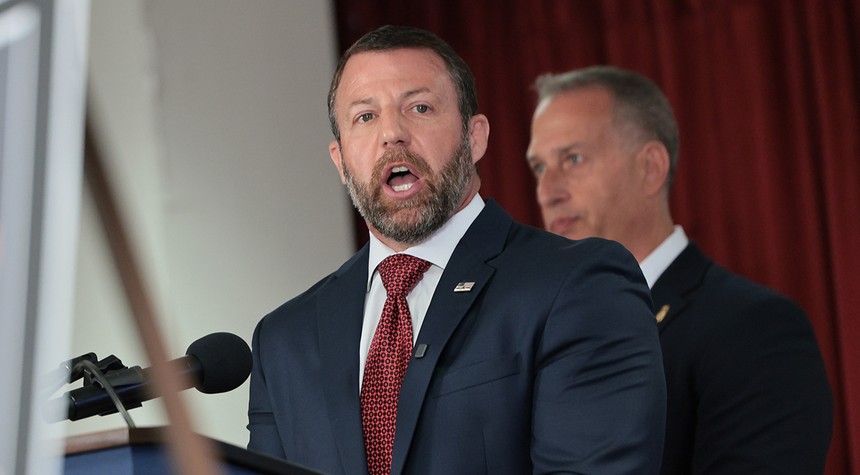
The Department of Homeland Security Secretary’s aircraft made an emergency landing Wednesday afternoon after suffering engine failure while en route from Georgia to the nation’s capital.
Secretary Markwayne Mullin was traveling aboard a U.S. Coast Guard C-37A Gulfstream V jet when the right engine failed, forcing pilots to divert to Ronald Reagan Washington National Airport in Virginia. Audio recordings captured the pilot’s calm but urgent communication with air traffic control.
“We just lost our right engine and would like to declare an emergency and immediate landing,” the pilot reported to the control tower. The aircraft carried fourteen people and maintained sufficient fuel reserves for two and a half hours of flight time.
The Coast Guard pilots successfully executed a single-engine landing without incident. Secretary Mullin praised their professionalism in the aftermath, noting on social media that the crew displayed no panic, only straightforward competence. The pilots later informed him that this emergency marked their first experience with such a failure.
The incident draws renewed attention to longstanding concerns about the age and condition of the Department’s aviation fleet. The aircraft involved, designated C101, was among several planes the Department flagged last year due to advancing age. According to Department assessments from earlier this year, the C101 has exceeded twenty years of service, surpassing Gulfstream’s recommended service life and far exceeding normal operational usage hours for corporate aircraft.
These concerns mirror broader maintenance challenges facing Coast Guard equipment. Department officials have previously acknowledged that Coast Guard vessels and aircraft alike have operated well beyond their intended service lives, raising questions about operational safety and effectiveness.
The aircraft age issue became particularly contentious last year when then-Secretary Kristi Noem authorized the purchase of two Gulfstream G700 jets for Coast Guard use. The acquisition, costing between $172 million and $200 million, significantly exceeded her initial $50 million budget request and prompted congressional scrutiny.
Democratic lawmakers questioned the administration’s priorities in May, with Representatives Bennie Thompson of Mississippi and LaMonica McIver of New Jersey pressing the Department on why executive aircraft upgrades took precedence over modernizing aging Coast Guard search-and-rescue planes used in lifesaving operations.
Department officials defended the expenditure, arguing that comprehensive fleet modernization remained essential. Former Assistant Secretary Tricia McLaughlin stated that the administration was taking necessary action to restore the Coast Guard to full operational capability as the nation’s premier maritime service.
Wednesday’s emergency landing resulted in no injuries and demonstrated the skill and training of Coast Guard aviation personnel. However, it underscores the practical consequences of operating aging equipment and the ongoing debate over resource allocation within the Department of Homeland Security.
The incident serves as a reminder that government officials rely daily on equipment and personnel whose readiness directly affects not only executive operations but also the Coast Guard’s broader mission of maritime security, law enforcement, and search-and-rescue operations along American coastlines.
Related: President’s Granddaughter Opens Up About Leaving Home for College Athletics
