
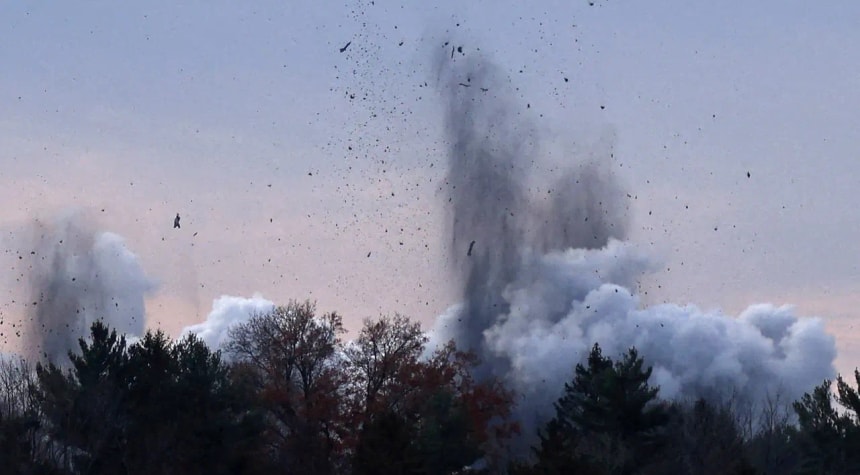
The United States Army successfully detonated nearly five tons of degraded lead azide at its ammunition plant in Middletown, Iowa, on Wednesday morning, bringing to a close weeks of legal wrangling and community concern over the volatile explosive materials.
Two distinct explosions reverberated through the area at approximately nine o’clock local time. Major General Eric Shirley, commanding general of the United States Army Sustainment Command, confirmed in a subsequent press conference that all sixty-eight barrels of lead azide had been definitively removed. The detonation produced no secondary explosions, no notable dust dispersal, and no damage to surrounding infrastructure.
"I believe, absolutely, that we reduced as close to zero as is absolutely humanly possible the risk to the health and safety of the people of Middletown and the extended communities throughout Iowa," Shirley stated.
By midday Eastern time, Environmental Protection Agency air monitors positioned along the expected plume path had detected no lead in their readings. A senior administration official characterized the operation as having exceeded all expectations, with maximum mitigation achieved. President Trump confirmed on social media that early reports indicated the mitigation efforts had been successful.
Missouri Governor Mike Kehoe, whose state’s northeastern corner lay within the projected blast plume path, confirmed the explosion occurred and indicated that mitigation measures appeared successful and the explosion well-contained.
The Army had constructed extensive barriers and deployed specialized gels to absorb potential fallout, responding to concerns from residents and environmental advocates who had warned that detonating the bomb-making materials risked blanketing the surrounding community in toxic lead dust. Shirley credited aqueous foam barriers with helping to contain the blast.
FEMA Administrator Cameron Hamilton reported a palpable sense of relief at the Army’s command center following the detonation. He stated that the explosion appeared effective at containing lead particles and that the anticipated lead plume evident in projection models had not materialized. Federal agencies will conduct air and soil sampling in coming days and weeks, while Agriculture Department officials will assess impacts on nearby farms.
Iowa’s Democratic governor-elect Rob Sand acknowledged the successful detonation while criticizing the process leading up to it. "The lead-up to the detonation should never have been so chaotic and unclear," Sand said, calling for immediate transparency regarding how the situation developed and demanding that any affected Iowans receive full and immediate care.
Army and federal officials had concluded that a controlled detonation of the lead azide represented a far safer alternative to a spontaneous explosion. The material had crystallized, rendering it extremely sensitive to heat, shock, and friction. Officials warned that freezing temperatures could further destabilize the material and trigger an uncontrolled blast.
The Army discovered the crystallization during a routine inspection in March, according to Acting Army Secretary Adam Telle. Military officials initially explored alternatives including chemical neutralization by private contractors, thermal treatment, and relocation. However, officials determined that opening the unstable barrels to introduce neutralizing chemicals risked triggering an immediate explosion.
The Environmental Protection Agency issued an emergency permit authorizing the detonation on November thirteenth. When the Army scheduled the operation for November twentieth, environmental organizations filed suit against the EPA, temporarily halting the plans. President Trump ordered the Army not to proceed without court approval, which was granted Monday when the Eighth Circuit Court of Appeals lifted its stay on the operation.
The successful completion of this delicate operation now allows federal and state officials to focus on comprehensive environmental monitoring and assessment of the blast site and surrounding areas.
Related: Tiger Woods Loses Trademark Battle as Court Rules in Favor of Louisiana Company