
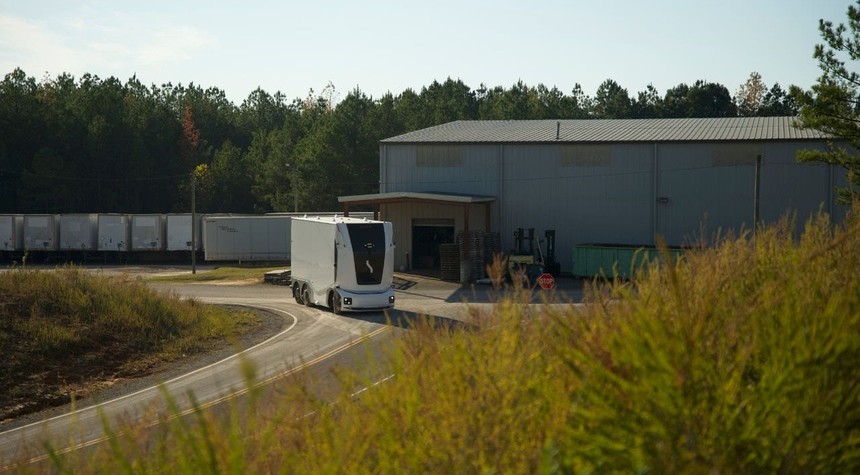
The future of American trucking has arrived on the roads of Marysville, Ohio, where fully autonomous electric semitrucks without cabs are beginning real-world operations this summer.
EASE Logistics, an Ohio-based freight company, has partnered with autonomous vehicle manufacturer Einride to deploy two cab-less electric trucks between warehouse locations. The vehicles represent a significant departure from traditional trucking technology. These are not conventional semitrucks equipped with self-driving features and a human backup driver. Rather, they are purpose-built autonomous vehicles with no driver’s seat, no steering wheel, and no cab whatsoever.
The trucks operate using SAE Level 4 autonomous technology, meaning they can drive themselves under specific approved conditions without requiring a human operator inside the vehicle. However, the operation maintains human oversight through remote monitoring. Off-site operators will supervise the trucks and retain the ability to intervene when circumstances require it.
The deployment is proceeding as a proof-of-concept service, with the vehicles operating both on EASE property and local public roads. The companies will collect data on warehousing, distribution and transportation operations as the trucks move goods between warehouse facilities.
This initiative operates under the framework of the Ohio Department of Transportation’s DriveOhio Truck Automation Corridor Project, developed in partnership with the Indiana Department of Transportation. The stated objective is to evaluate how autonomous trucking technology affects operational efficiency, safety protocols and freight movement.
The questions raised by this technology are substantial. The American trucking industry employs millions of drivers and represents a cornerstone of the nation’s economic infrastructure. The introduction of fully autonomous vehicles without human operators aboard challenges fundamental assumptions about transportation safety and workforce stability.
Proponents argue that autonomous technology could address the persistent driver shortage affecting the industry while potentially improving safety through the elimination of human error, fatigue and distraction. The technology operates continuously without requiring rest breaks, and its sensors and processing systems maintain constant vigilance.
Critics raise concerns about the reliability of autonomous systems in unpredictable real-world conditions, the cybersecurity vulnerabilities of remotely monitored vehicles, and the economic impact on professional drivers and their families. The technology also presents regulatory challenges, as existing transportation law was written with human operators in mind.
The Marysville pilot program will provide concrete data on these questions. The controlled environment, limited routes and remote oversight represent a measured approach to testing technology that could reshape American freight transportation.
What remains to be seen is whether the technology proves itself safe, reliable and economically viable at scale. The summer testing period in Ohio will offer important evidence as policymakers, industry leaders and the American public consider the role of fully autonomous trucks on our nation’s highways.
That is the way it is.
Related: Phone Data Prompts New Search Area for Missing Michigan Woman in Bahamas
