
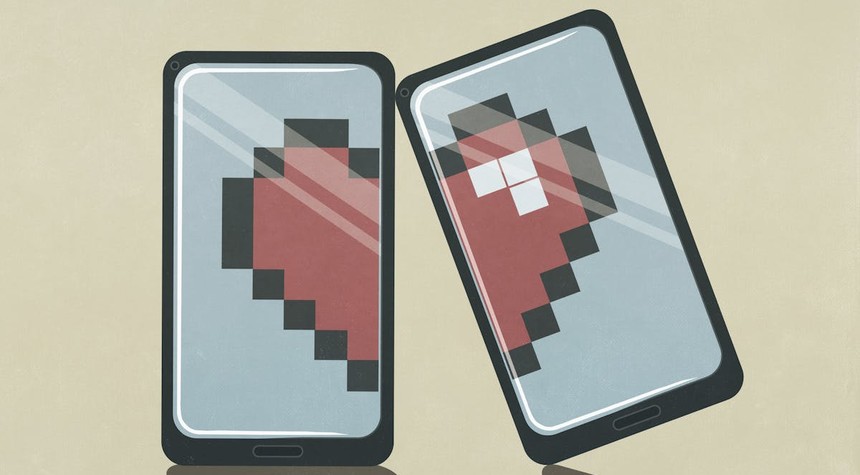
The transformation of American courtship from personal connection to statistical analysis represents one of the more troubling social developments of our digital age. What was once a matter of the heart has become, for millions of young Americans, an exercise in spreadsheet management.
Last year’s film “Materialists” captured this phenomenon with uncomfortable accuracy. The romantic drama depicted a world where potential partners are evaluated through metrics—height, salary, hairline—as though human beings were baseball cards to be traded and collected. While the film focused on an upscale New York matchmaker, the real architect of this cold calculus is far more pervasive: the dating application.
The film resonated with audiences not because it exaggerated reality, but because it held up a mirror to it. Characters speak casually of “stats” and “market value,” reducing the ancient and profound human search for companionship to the language of commodity trading.
To be clear, the existence of personal preferences in mate selection is not new. Unrequited love and romantic disappointment have been constants of the human condition since time immemorial. What has changed is the system itself, which now trains users to view every potential romantic interest as a collection of data points rather than as a complete human being.
For those fortunate enough to have found their partners before the smartphone era, the current dating landscape can be difficult to comprehend. Even the email-based courtship of the late 1990s, when a single-digit percentage of couples met online, seems charmingly innocent by comparison. Today, more than half of all couples meet through digital means, primarily dating applications. What was once a novelty has become an unavoidable reality for those seeking companionship.
The results have been disappointing. Despite the proliferation of these digital matchmaking services, singles report that the dating market has deteriorated rather than improved. The majority of unmarried Americans say their dating lives are unsatisfactory and that finding suitable partners has become increasingly difficult. Nearly half report that dating has grown markedly harder over the past decade.
These perceptions align with objective measures. The average age of first marriage continues to rise, while marriage rates have fallen to historic lows. After years of promises that technology would streamline the path to lasting partnership, we find ourselves further from that goal than before.
The problem lies not in choice itself, but in how these applications present that choice. Dating apps employ gambling mechanics designed to maximize user engagement, combined with a reductive format that distills human beings into a few photographs, a brief biographical statement, and a handful of sortable characteristics such as height, occupation, education level, and political affiliation.
This design is not accidental. It serves the business model of these platforms, which profit from prolonged user engagement rather than successful matches. The swiping mechanism encourages rapid, superficial judgments based on minimal information, training users in a form of romantic decision-making that would have seemed alien to previous generations.
The consequences extend beyond individual disappointment. As these applications become the dominant means of meeting potential partners, their limitations reshape expectations and behavior across the entire dating market. The shallow evaluation they encourage becomes normalized, affecting even those who meet through traditional means.
This represents more than a technological inconvenience. It touches upon fundamental questions about human connection and the formation of families, the basic building blocks of society. When the tools we use to find life partners are designed to keep us searching rather than finding, we must ask whether we are being well served by this particular innovation.
And that is the way it is.
Related: Tensions Flare Between Senators During Surgeon General Nomination Discussion
