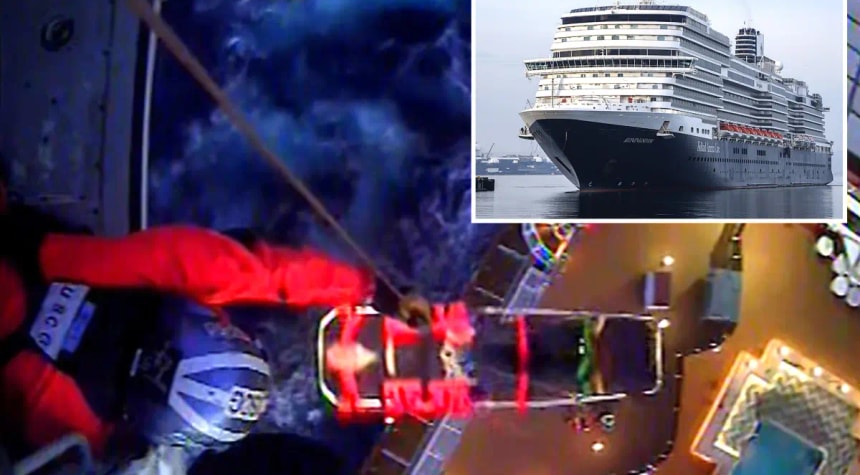
A medical emergency eighty miles off the California coast required the United States Coast Guard to dispatch a rescue helicopter in the predawn hours to evacuate a seventy-four-year-old passenger experiencing symptoms of a possible heart attack.
The incident occurred aboard the Koningsdam, a nearly one-thousand-foot cruise vessel operated by Holland America Line and sailing under Dutch registry. The ship’s captain contacted Coast Guard authorities to request assistance for the ailing passenger, setting in motion a carefully coordinated rescue operation.
Coast Guard Air Station Ventura received the evacuation request at approximately three o’clock in the morning. After consultation with the duty flight surgeon, officials dispatched an MH-60 Jayhawk helicopter to the scene. The aircraft reached the cruise ship at approximately quarter to six in the morning, where the crew successfully lifted the passenger aboard before transporting him to Scripps Memorial Hospital in La Jolla for treatment.
Lieutenant Aiden Becker, a search and rescue mission coordinator with Coast Guard Sector San Diego, emphasized the complexity of such operations. Responding to medical emergencies aboard vessels far offshore requires careful coordination and a timely response to ensure patients receive the medical care they need, Becker explained. Coast Guard crews undergo specialized training to carry out such rescues and safely transfer patients into the care of medical personnel.
Authorities have not provided an update on the passenger’s condition following his arrival at the hospital.
The Koningsdam belongs to Holland America Line’s Pinnacle-class fleet and regularly departs from San Diego on itineraries that include destinations along the Pacific Coast and Mexican ports.
This rescue follows another remarkable Coast Guard operation conducted last month in the same waters. An eighty-six-year-old sailor and his canine companion were recovered nearly five hundred miles off the San Diego coast after disappearing during an ambitious months-long voyage from Oregon to the South Pacific.
The elderly mariner and his dog had departed aboard the Willow Wind from Astoria, Oregon, in August, bound for Pago Pago in American Samoa, a remote destination roughly five thousand miles southwest of California. The pair had not been heard from since August twentieth, prompting concern when they failed to arrive as expected.
Coast Guard Pacific Area watchstanders received notification about the overdue sailor on October twenty-fourth. Days later, the search intensified when an emergency radio beacon alert from the Willow Wind was detected. Multiple Coast Guard aircraft were dispatched, and nearby vessels were called upon to assist.
The sailboat was eventually located, and the motor vessel Grand Orion arrived at the scene. However, treacherous seas forced rescuers to suspend operations for several hours before they could safely reach the stranded sailor and his dog. The pair were successfully pulled from the sailboat, which had been left adrift with damaged sails.
A Coast Guard helicopter crew then hoisted the sailor and his dog from the Grand Orion approximately one hundred seventy miles west of Ventura. When emergency medical personnel evaluated the mariner, he was weak and had difficulty walking, but had sustained no major injuries. He was transported to Scripps Mercy Hospital for further evaluation.
By the time they were found, the sailor and his companion had traveled more than one thousand nautical miles during their ordeal at sea.
Commander Jason Nguyen, Southwest District command center chief, expressed gratitude for the coordinated efforts that brought the search to a successful conclusion. This case highlights the importance of carrying emergency communication equipment and creating a float plan so someone ashore knows your voyage plans, Nguyen stated.
Related: New York Releases Man Convicted in Barnard Freshman’s Fatal Stabbing