
A young boy’s candid expression of excitement about America’s return to the moon has captured the attention of the nation and NASA’s highest leadership.
During coverage of the Artemis II launch on Wednesday, footage aired showing a child being interviewed about the historic mission. When asked why he wanted to witness the event and what drew him to space exploration, the youngster delivered a response that cut through the usual platitudes with refreshing directness.
“We’re going back to the fricking moon. That’s why!” the child exclaimed, his enthusiasm evident and unvarnished.
The moment struck a chord with Americans across the country who shared the sentiment on social media platforms. The boy’s authentic excitement served as a reminder of the wonder that space exploration can inspire in younger generations, recalling an era when the entire nation looked skyward with anticipation.
NASA Administrator Jared Isaacman took notice of the viral moment and responded publicly, announcing that the young space enthusiast would receive a bag of NASA gear. The gesture underscored how the child’s genuine enthusiasm embodied the spirit NASA hopes to cultivate as America embarks on its renewed lunar exploration program.
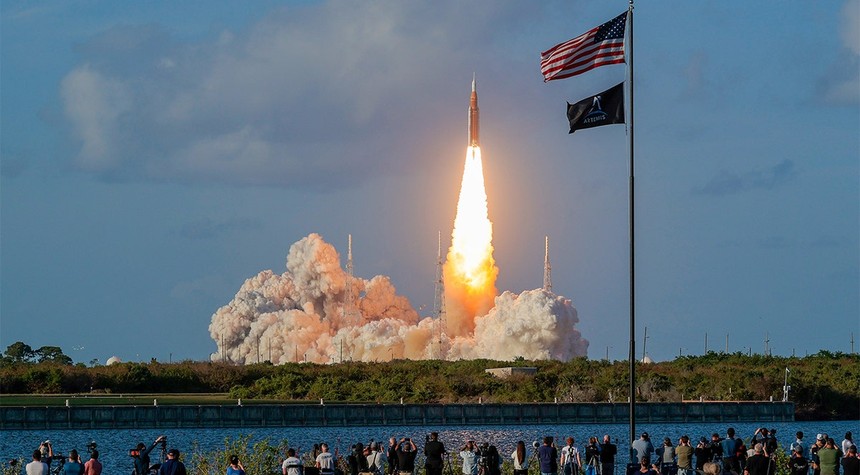
The Artemis II mission represents a significant milestone in American space exploration. The Space Launch System rocket, carrying the Orion spacecraft, lifted off from Launch Complex 39B at Kennedy Space Center on April 1. This mission marks a crucial step in NASA’s broader Artemis program, which aims to establish a sustained human presence on the moon and eventually serve as a stepping stone for missions to Mars.
The program has garnered bipartisan support as both a scientific endeavor and a matter of national security. As one former administration official noted, space represents not merely a frontier for exploration but the ultimate strategic high ground in an increasingly competitive global landscape.
The child’s viral moment comes at a time when NASA seeks to reinvigorate public interest in space exploration, particularly among younger Americans who did not experience the Apollo era firsthand. His unscripted enthusiasm may prove more effective than any carefully crafted public relations campaign in conveying why America’s return to the moon matters.
The Artemis program faces substantial technical and budgetary challenges ahead, but moments like this young boy’s honest declaration serve as reminders of what drives human exploration beyond our planet. It is not merely about scientific advancement or geopolitical positioning, though both remain important considerations. It is also about maintaining that sense of wonder and possibility that has defined American innovation throughout our history.
As the Artemis II mission proceeds, one can hope that this child’s excitement proves contagious, inspiring a new generation to look upward and outward, asking not merely what lies beyond our world, but how Americans might reach it.
That is the spirit that took us to the moon five decades ago. And that is the spirit, embodied in one young boy’s forthright enthusiasm, that may well take us back again.
Related: Fairfax County Infant Death Investigation Reveals Suspect’s Immigration Status
