
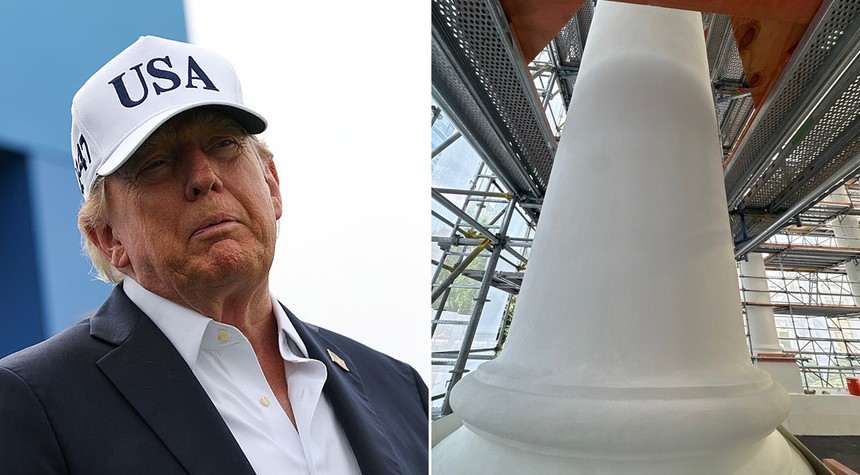
President Donald Trump provided reporters with a tour of ongoing construction projects at the White House this week, revealing the scope of renovations undertaken to address what he described as serious structural deterioration of the historic building.
In a statement released Sunday, the president characterized the condition of the White House prior to these improvements as deplorable, asserting that previous administrations had neglected necessary maintenance of the structure.
“The White House was in very bad condition, both inside and out. Frankly, it was a ‘dump!’ Past Presidents did not take care of it,” Trump stated. He added that he has personally devoted attention to the renovation efforts despite limited available time.
The president commended the work being performed by the Department of the Interior and contracted firms, describing their efforts as exemplary. According to Trump, the exterior facade of the building had reached a state of near failure. “The exterior ‘skin’ of the Building was practically falling off! It is now in better shape than when built in 1792. Such an Honor to have the privilege of saving this Great Structure!” he wrote.
The president contended that further delay in addressing these maintenance issues would have resulted in irreparable damage to what he termed “our beloved White House.”
The renovation program encompasses both structural repairs and aesthetic modifications. Among the changes implemented or proposed are reinforcements to the North Portico entrance, the addition of gold decorative elements in the Oval Office and Cabinet Room, alterations to the Rose Garden landscape, and the demolition of the East Wing to accommodate plans for a substantial 90,000-square-foot ballroom facility.
These projects have generated controversy among architectural preservationists and sparked legal challenges from those concerned about the historical integrity of the presidential residence.
The administration’s renovation efforts extend beyond the White House itself. Significant work has been undertaken at other prominent Washington landmarks, including restoration of the Lincoln Memorial Reflecting Pool. Proposals under consideration include repainting the Eisenhower Executive Office Building and conducting extensive renovations at the Kennedy Center for the Performing Arts.
The scope and pace of these changes represent one of the most ambitious renovation programs undertaken at the White House in recent decades. While the administration maintains that these efforts are necessary to preserve and enhance these important national structures, critics have raised questions about the appropriateness of certain aesthetic choices and the speed at which historically significant elements are being modified.
The debate reflects broader tensions between preservation and modernization that often arise when dealing with historic government buildings. As these projects continue, they will likely remain subjects of public discussion regarding the proper stewardship of America’s architectural heritage.
Related: Baltimore Parents Face Child Abuse Charges After Infant Dies From Severe Head Trauma