
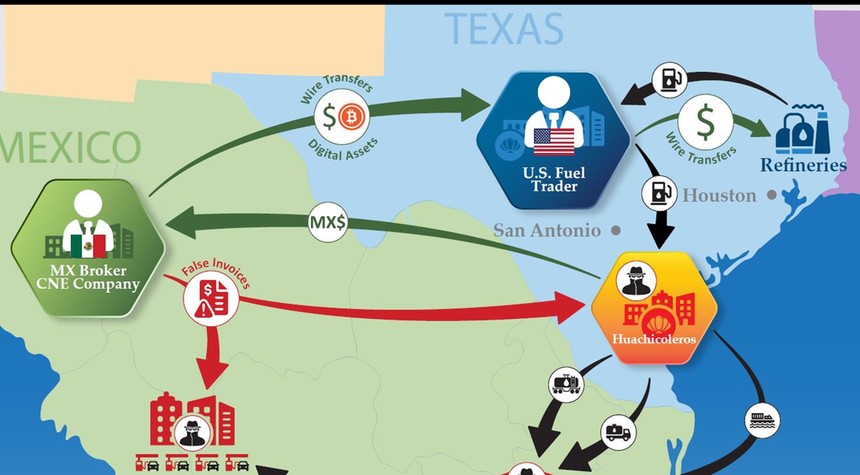
The United States Treasury Department announced comprehensive sanctions this week against the Jalisco New Generation Cartel, targeting what officials describe as a sophisticated fuel theft operation that generates tens of millions of dollars annually for Mexico’s most powerful criminal enterprise.
Treasury’s Office of Foreign Assets Control imposed sanctions on two Mexican nationals and nine companies spanning transportation, financial services, and real estate sectors. These entities stand accused of participating in an elaborate scheme to steal fuel and evade Mexican taxes, funneling the proceeds directly to cartel operations.
In a coordinated effort, Treasury’s Financial Crimes Enforcement Network issued guidance to American financial institutions, outlining specific indicators of fuel smuggling activities from the United States into Mexico. The alert aims to help banks identify and report suspicious transactions tied to Mexican tax evasion schemes.
Treasury Secretary Scott Bessent emphasized the evolving nature of cartel operations in his statement accompanying the announcement. The cartels are expanding well beyond their traditional drug trafficking activities to establish diverse revenue streams, even as they continue flooding American communities with deadly narcotics.
The scope of the Jalisco New Generation Cartel’s influence is staggering. The Drug Enforcement Agency confirms the organization maintains operations in 21 of Mexico’s 32 states, surpassing even the notorious Sinaloa Cartel, which operates in 19 states. Last year, President Trump formally designated the Jalisco New Generation Cartel and five other Mexican criminal organizations as foreign terrorist organizations.
The fuel theft operations represent a particularly brazen criminal enterprise. Organized crime groups physically tap into pipelines and divert fuel to service stations, which face a stark choice: purchase from the cartels or face violent consequences. Some operations involve direct street sales. American authorities have documented cases where the Jalisco cartel operates its own service stations as fronts for the illegal fuel trade.
Mexican authorities have seized millions of gallons of stolen diesel, gasoline, and petroleum distillates in recent years, particularly in states bordering Texas. The scale of these seizures underscores the magnitude of the theft operations.
Recent enforcement actions have struck significant blows against the cartel’s leadership structure. Last month, federal prosecutors expanded charges against the organization’s second-in-command, known as “The Gardener,” adding methamphetamine trafficking and money laundering conspiracy to his indictment.
On April 27, Mexican Navy special forces arrested Audias Flores Silva in Nayarit state, acting on intelligence provided by American agencies. Flores Silva was considered a potential successor to the cartel’s supreme leader, Nemesio Oseguera Cervantes, known as “El Mencho,” who was killed during a military operation in February.
The death of “El Mencho” triggered widespread violence across affected regions. Cartel gunmen launched coordinated attacks on businesses, burned vehicles, and erected road blockades. The violence claimed more than 70 lives, including 25 National Guard members who died defending their communities against the criminal onslaught.
These latest sanctions represent another tool in the ongoing effort to dismantle the financial networks that sustain cartel operations. Whether economic pressure alone can succeed where military operations have struggled remains an open question, but American officials appear determined to attack the problem from every available angle.
Related: New Jersey Congressman Returns to House After Four Month Medical Leave for Depression
