
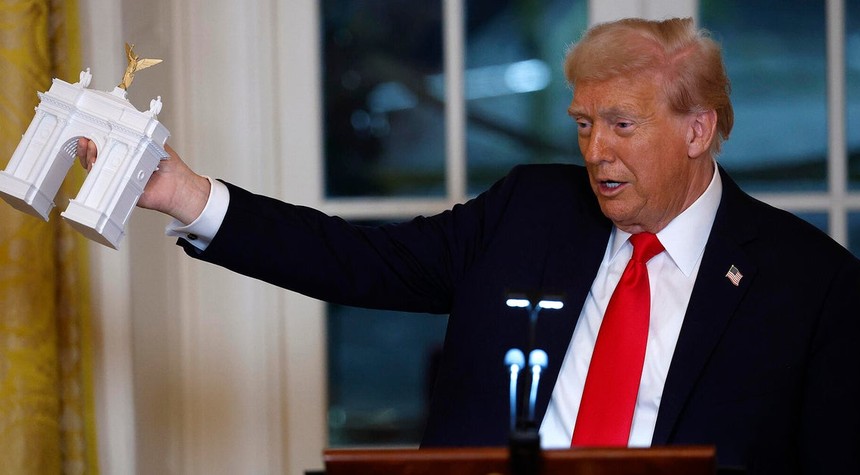
The White House has confirmed that President Trump is moving forward with plans to construct what would be the world’s tallest triumphal arch at the gateway to Washington, envisioning a 250-foot monument to mark the nation’s 250th anniversary.
The proposed Independence Arch would stand significantly taller than Paris’s famed Arc de Triomphe, which reaches 164 feet, and would surpass even Mexico City’s Monumento a la Revolución, currently the world’s tallest such structure at 220 feet. For perspective, the Lincoln Memorial, which would sit opposite the arch across the Memorial Bridge, stands at 99 feet.
“I’d like it to be the biggest one of all,” the President told reporters aboard Air Force One on Sunday evening. “We’re the biggest, most powerful nation.”
The ambitious project faces considerable logistical challenges, not least of which is its proximity to Reagan National Airport in Arlington, Virginia. The proposed site sits along an active flight path, raising questions about aviation safety and federal airspace regulations. Current flight restrictions already prohibit aircraft from crossing over the National Mall and the Pentagon, forcing commercial and private planes to navigate carefully defined corridors around the capital’s most sensitive areas.
White House officials indicated that the design remains under refinement and that the administration will seek necessary approvals from both the Commission of Fine Arts and the National Capital Planning Commission. These bodies have historically served as gatekeepers for architectural projects in the nation’s capital, ensuring that new structures complement the city’s classical aesthetic and respect established sight lines and monuments.
The Commission of Fine Arts, established in 1910, advises the federal government on matters of design and aesthetics in Washington. The National Capital Planning Commission, meanwhile, holds statutory authority over development in the District of Columbia and surrounding federal properties. Both entities have occasionally clashed with presidential ambitions for the capital’s landscape throughout their histories.
The timing of the proposal aligns with the approaching semiquincentennial of American independence in 2026, though the scale of such a project raises questions about whether construction could be completed within that timeframe. Major monuments in Washington have historically required years of planning, fundraising, and construction.
The President’s vision for the arch represents his administration’s broader emphasis on grand architectural statements and American exceptionalism. The proposed structure would serve as a ceremonial gateway to the capital city, though specific details about its design, materials, and exact location have not been fully disclosed.
As this proposal advances through the federal approval process, it will undoubtedly spark debate about the appropriate scale and character of monuments in the nation’s capital, the practical implications of constructing such a massive structure near a major airport, and the broader question of how America should commemorate its founding.
The coming weeks will reveal whether the President’s ambitious vision can navigate the complex web of regulations, commissions, and practical concerns that govern development in the nation’s most symbolically important city.
Related: Lindsey Vonn Returns to Training Days After Complete ACL Rupture
