
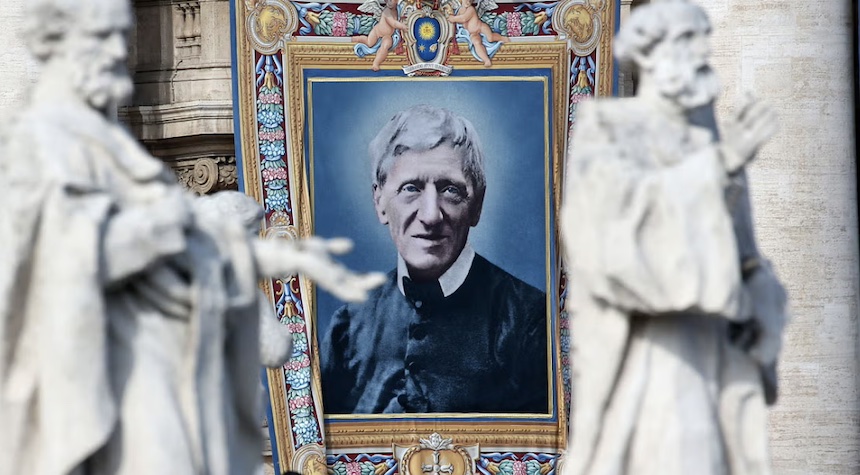
Pope Leo XIV has announced his intent to declare St. John Henry Newman a “doctor” of the church, one of the Catholic Church’s most distinguished accolades. This honorary title is set to be conferred upon the influential 19th-century Anglican convert, hailed by both conservatives and progressives as a unifying figure.
The Vatican confirms that Pope Leo has agreed with the Vatican’s saint-making office’s recommendation, made during an audience with its prefect, Cardinal Marcello Semeraro. The formal declaration is expected to be made imminently.
Newman, a respected theologian and poet, is revered for his profound discourses on doctrine development, truth, and the essence of a university. His steadfast commitment to his conscience — even at great personal cost — has won him admiration among Catholics and Anglicans alike. Newman’s journey from the Church of England to the Catholic Church in 1845 led to significant personal loss, including friendships, work, and even family ties, as he pursued what he believed to be the truth found only in the Catholic faith.

The title of doctor is traditionally reserved for figures whose writings have made significant contributions to the universal Catholic Church. A mere three dozen individuals have received this honor, including the 5th-century St. Augustine, St. Francis de Sales, and St. Teresa of Avila.
Newman’s inclusion in this esteemed list underscores his influence on Christian understanding of conscience and education. His appeal spans across the spectrum of progressive and conservative thought, making him a unifying figure in an often polarized church.
The significance becomes clear when we consider the Vatican’s criteria for declaring a church doctor, which include the candidate’s holiness in life, the prominence of their doctrinal and theological teaching, and their lasting influence on the church. According to experts, Newman fulfills these rigorous requirements.
The evidence suggests that Newman’s impending recognition as a Doctor of the church not only represents an affirmation of his theological contributions but also resonates with Pope Leo’s commitment to unity and peace.
