
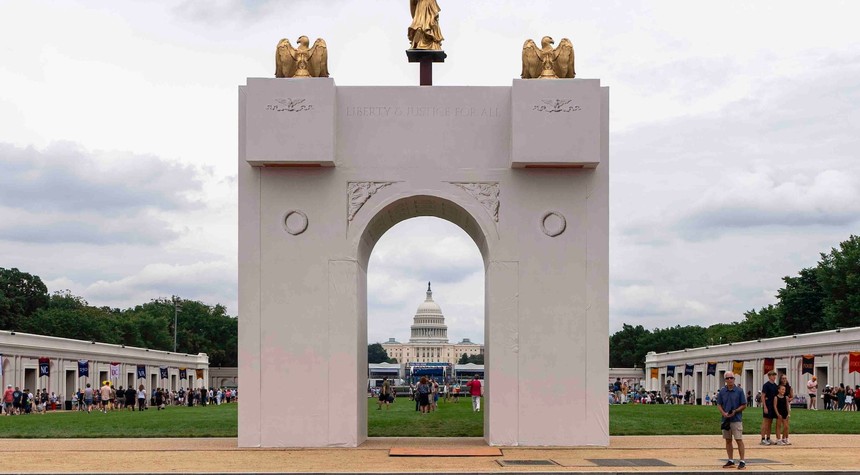
The National Park Service has released a comprehensive report supporting President Donald Trump’s proposed memorial arch in Washington, even as the agency acknowledges the structure would significantly affect sightlines between some of the nation’s most revered landmarks.
The 133-page assessment, made public Friday, concludes that the 250-foot arch would disrupt the visual relationship between the Washington Monument, Lincoln Memorial, and Jefferson Memorial, among other historic sites. Yet the Park Service maintains that the proposed location adjacent to Memorial Bridge represents the most historically appropriate site for the commemorative structure.
The report addresses a fundamental tension in the project. Washington’s monumental core has been carefully planned over generations, with deliberate sightlines connecting various landmarks to convey historical narrative and national symbolism. The proposed gilded arch would interrupt many of these carefully orchestrated visual relationships.
Most notably, the structure would break the alignment between the Lincoln Memorial, Memorial Bridge, and Arlington House, the former residence of Confederate General Robert E. Lee. This alignment was established to physically and symbolically unite North and South through coordinated monumental architecture extending across the Potomac River.
The Park Service catalogued dozens of historic properties whose integrity would be affected by the arch. The list includes the National Mall, the United States Capitol, the Washington Monument, the Jefferson Memorial, the Georgetown Historic District, the Old Naval Observatory, Key Bridge, and the National Cathedral.
Despite these acknowledged impacts, the Park Service argues that relocating the arch or eliminating its principal commemorative features would undermine the project’s fundamental purpose. The report states that the very characteristics making Memorial Circle preservation-sensitive also make it the historically appropriate location for the undertaking.
The agency concluded that alternative locations outside Memorial Circle do not represent reasonable avoidance options, as the project’s effects cannot be fully mitigated without fundamentally altering its design or purpose.
This federal assessment arrives at a critical juncture for the proposed monument. The project received initial approval from a key federal commission last month but faces legal challenges from three veterans and a group of historians who contest its placement and potential impact on existing memorials.
The Park Service report may prove consequential in the ongoing legal battle over the arch. The administration is expected to cite the assessment as expert support for proceeding with construction at the Memorial Circle location despite the visual impacts on surrounding historic properties.
The proposed arch represents one of the most ambitious additions to Washington’s monumental landscape in decades. At 250 feet, the structure would rival many existing monuments in scale and prominence, fundamentally altering the capital’s skyline and the visual experience of visiting its historic core.
The debate over the arch reflects broader questions about how America commemorates its history and whether new monuments should defer to existing arrangements or assert their own presence in the national landscape. The Park Service has now weighed in with its assessment, supporting the administration’s vision while documenting the trade-offs involved.
Related: Vandalism at World War II Memorial Results in Federal Indictment
