
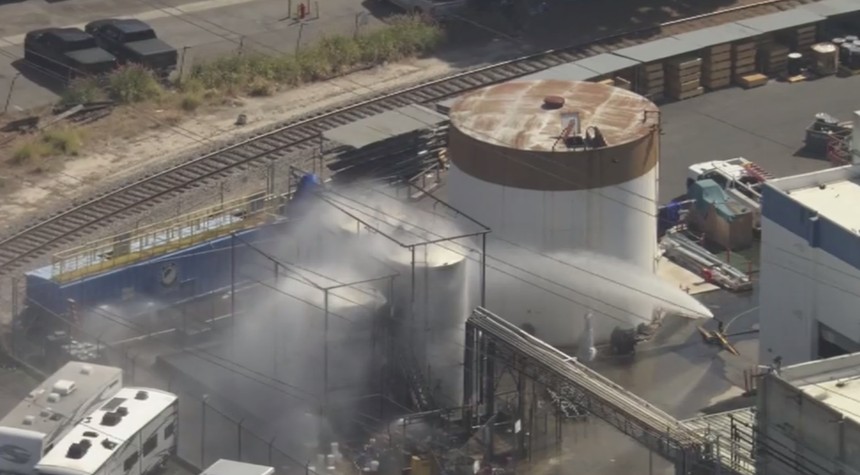
More than 44,000 residents of Southern California remained displaced from their homes Saturday evening as authorities grappled with a deteriorating industrial tank containing thousands of gallons of highly volatile chemicals that could fail at any moment.
The crisis centers on a storage tank at an aerospace facility in Garden Grove, Orange County, which holds an estimated 7,000 gallons of methyl methacrylate. This highly flammable and toxic substance, commonly used in plastics manufacturing, has placed six surrounding communities under mandatory evacuation orders.
Orange County Fire Authority Chief Craig Covey delivered a sobering assessment of the situation during a Friday afternoon briefing. The compromised tank’s cooling system has failed, and despite efforts to stabilize the temperature, authorities acknowledge that complete failure appears inevitable. The question is not if, but when.
“This thing is going to fail. We do not know when,” Chief Covey stated plainly. A 32-year veteran of fire service, he characterized this incident as the most dangerous event of his career.
The evacuation zone encompasses a one-mile radius affecting residents in Garden Grove, Cypress, Stanton, Anaheim, Buena Park, and Westminster. Officials have provided no timeline for when residents might safely return to their homes.
The facility houses three tanks in total. Firefighters have successfully maintained temperature control of the compromised tank, buying precious time for experts to devise a solution. However, two scenarios loom. In the first, the tank fails structurally and spills its entire contents across the facility grounds. In the second, more catastrophic scenario, the tank undergoes thermal runaway and explodes, potentially triggering a chain reaction with adjacent tanks containing fuel and additional chemicals.
Chief Covey emphasized that the potential scope and severity of an explosion remains unclear, as does the timeline for any failure. Authorities are preparing for the worst while working toward better outcomes.
A specialized team has been assembled to explore unconventional solutions. The county hazardous materials unit has reached out to experts across California and throughout the nation, seeking methods to safely depressurize the affected tank and minimize exposure risks.
Authorities report that current air quality monitoring shows no harmful substances being released. Cooling efforts have successfully reduced the tank’s temperature enough to stop the purge valve from venting chemical vapors. This represents a critical achievement in managing immediate public health risks.
Several hours after the initial briefing, Chief Covey provided a cautiously optimistic update. The assembled team has generated what he described as “tremendous ideas” for alternative approaches to resolving the crisis. Temperature control efforts continue to prove effective, and officials are reconsidering strategies that would allow closer engagement with the compromised tank.
The incident underscores the inherent risks associated with industrial chemical storage in densely populated areas. As authorities work around the clock to prevent disaster, tens of thousands of displaced residents await word on when they might safely return home.
For now, the situation remains fluid, with emergency personnel maintaining constant vigilance over a tank that could fail without warning and unleash consequences that even experienced fire officials struggle to fully predict.
Related: Congress Moves Forward on Ending Twice-Yearly Clock Changes
