
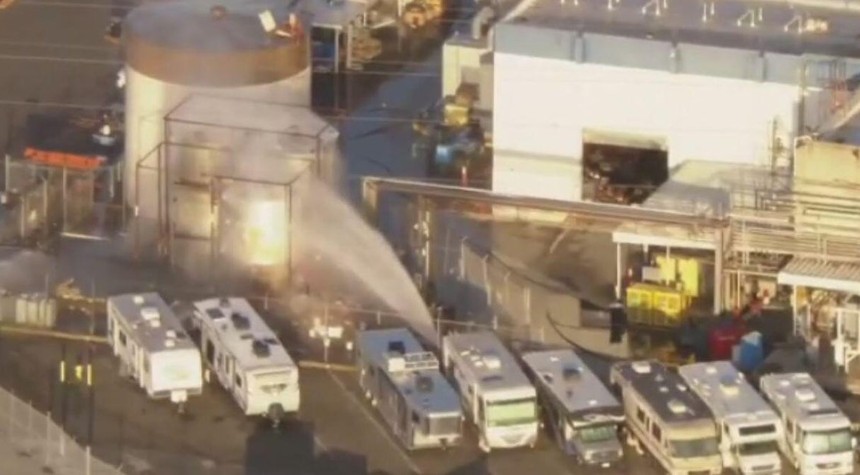
Firefighters in Orange County, California have successfully eliminated the threat of a catastrophic explosion at an aerospace facility, though more than 50,000 residents remain under mandatory evacuation orders as officials continue monitoring the situation.
Orange County Fire Authority Interim Chief TJ McGovern announced Monday that the threat of a BLEVE—a Boiling Liquid Expanding Vapor Explosion—has been removed at the GKN Aerospace facility in Garden Grove following an intensive overnight operation. The announcement brought welcome relief to a tense situation that had placed tens of thousands of residents in potential danger.
“We are happy to report that the threat of a BLEVE is now off the table,” McGovern stated. “That threat has been eliminated.”
The crisis began Saturday night when crews discovered a crack in a storage tank containing hazardous chemicals. The damage, believed to have resulted from a pressure release, raised immediate concerns about the possibility of a massive explosion that could have devastated the surrounding area.
By Monday, Incident Commander and Division Chief Craig Covey confirmed the crack’s existence and reported encouraging progress. The tank’s internal temperature had decreased from 100 degrees to 93 degrees Fahrenheit, a significant development in stabilizing the volatile situation.
“That is incredibly positive news as we turn the corner on this incident,” Covey said.
However, fire authority officials cautioned that dangers remain. While the worst-case scenario has been averted, flammable material inside the tank still poses risks. The substance could potentially burn and ignite, though on a far smaller scale than the BLEVE scenario that dominated initial concerns.
Public Information Officer Nick Garton emphasized that toxic chemicals could still leak from the tank. “It’s still a potential,” he explained. “We’re trying to confirm that there’s still a liquid form of this chemical that could potentially leak out.”
Garton clarified that no active leak currently exists, but additional cracks could form at the tank’s base. As pressure continues to decrease, however, the likelihood of such cracks diminishes.
Initial reports suggested multiple cracks existed in the tank, prompting the fire authority to issue a clarification. “To clarify, there is one known crack on the tank,” officials stated. “There is also peeling of weather stripping on the exterior, but this is not an additional crack.”
The confusion arose from the constant stream of water being directed at the tank, which caused weather stripping to peel away, creating the appearance of additional damage.
When firefighters first responded Saturday night, the tank’s internal temperature exceeded 100 degrees, more than double what officials described as the “happy place” for the stored substance. The elevated temperature significantly increased explosion risks and necessitated the large-scale evacuation.
Evacuation orders remain in effect for an undisclosed period as crews continue their careful monitoring of the situation. Officials have not provided a timeline for when residents might safely return to their homes.
The Trump administration has been briefed on the incident, according to White House officials, though no additional federal response has been announced at this time.
The incident underscores the inherent risks associated with industrial chemical storage in densely populated areas and the critical importance of rapid emergency response. The successful mitigation of this threat represents a significant achievement for Orange County’s fire response teams, whose round-the-clock efforts prevented what could have been a catastrophic event.
Related: Pentagon Faces Bipartisan Pressure Over Foreign Exploitation of Military Location Data
