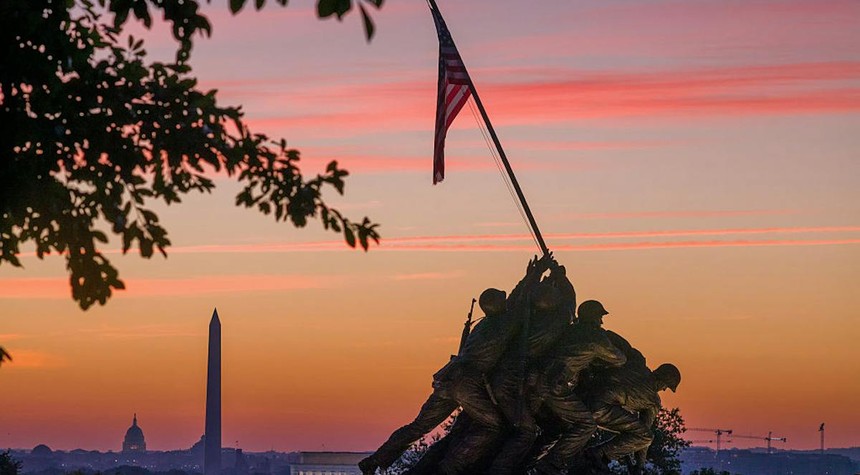
A twenty-seven-year-old man stands accused of taking a sledgehammer to the historic Iwo Jima memorial outside Marine Corps Base Quantico late Wednesday evening, causing extensive damage to the limestone tribute that has stood at the base’s entrance for decades.
Prince William County police apprehended Miguel Alonso Maldonado Soriano at approximately 10:15 p.m., discovering him in the act of striking the nine-foot statue with a sledgehammer. The damage inflicted upon the memorial is substantial. One of the Marines depicted in the famous flag-raising scene has been completely decapitated. A second figure lost the bayonet from his rifle, while a third sustained significant chipping and gouging to the helmet and face. Authorities estimate repair costs will reach hundreds of thousands of dollars.
Federal sources have confirmed that Maldonado Soriano, a resident of Stafford, entered the United States from Mexico in December 1999 as a minor. He received protection under the Deferred Action for Childhood Arrivals program in 2014 during the Obama administration and maintained that status for a decade, with his most recent renewal occurring in 2024 under the Biden administration. However, his protected status expired this past August when the current administration declined to renew it.
The suspect now faces felony charges for destruction of property and injury to a monument, in addition to a trespassing charge. He remains in custody without bond.
White House spokeswoman Taylor Rogers issued a statement addressing the incident. The administration characterized the attack as a deliberate act of disrespect toward American service members and emphasized its commitment to border security and deportation of individuals who commit crimes on American soil.
The damaged statue, carved by Felix de Weldon, who also created the iconic bronze memorial at Arlington National Cemetery, has weathered previous incidents. Vandals defaced the monument in 2012, and a severe windstorm in 2018 caused such extensive damage to the figures’ hands that officials had to temporarily remove the flag. At that time, Marines reportedly volunteered to repair the damage themselves, demonstrating the deep connection the service members feel toward this particular memorial.
The statue commemorates one of the most consequential battles of the Pacific theater in World War II. On February 19, 1945, United States Marines launched an assault on Iwo Jima, a small volcanic island located 750 miles south of Tokyo. The island’s strategic value lay in its airfields, which American forces needed for the final push toward Japan. Approximately 21,000 Japanese troops had fortified the island with an elaborate network of tunnels and bunkers, positioning themselves throughout the terrain dominated by Mount Suribachi.
Four days into the bloody campaign, a Marine patrol fought its way to the mountain’s summit and raised an American flag, a moment that became one of the most recognizable images in American military history.
The monument stands at the base’s main gate, adjacent to the National Museum of the Marine Corps, where it serves as a daily reminder to those who enter of the sacrifice and valor demonstrated by previous generations of Marines.
Related: Video Game Designer Manuel Otto Dies at 30 in Tragic Livestream Incident