
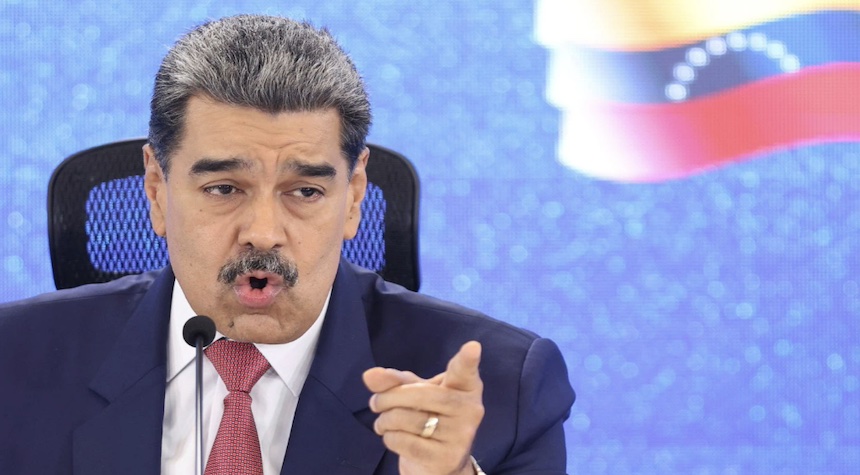
Venezuela’s President Nicolas Maduro has extended an offer to initiate direct talks with the administration of U.S. President Donald Trump. This development follows earlier reports of the first U.S. strike on a Venezuelan boat, which, according to Trump, was allegedly filled with drug traffickers.
In a letter addressed to President Trump, Maduro rejected U.S. claims of Venezuela’s significant involvement in drug trafficking. He asserted that a mere 5% of drugs produced in Colombia were being transported via his country, 70% of which, he claimed, were intercepted and subsequently eliminated by Venezuelan authorities.
In the aforementioned letter, Maduro expressed hope for debunking the falsehoods that have strained the U.S.-Venezuela relationship. He proposed a direct and candid conversation with Trump’s special envoy, Richard Grenell, to triumph over the distortion brought about by media distortions and misinformation. He also commended Grenell’s effective resolution of previous allegations that Venezuela refused to accept returning migrants, asserting that this communicative channel has operated flawlessly to date.
You May Also Like: Outrage in Phoenix: Man Arrested for Sickening Act at Charlie Kirk Memorial
Despite the U.S. strikes, deportation flights transferring illegal migrants from the U.S. to Venezuela have continued without disruption. This raises important questions about the impact of these strikes on diplomatic relations.

President Trump, on his social platform, has intensified his pressure campaign. He demanded that Venezuela accept the return of all prisoners he claimed were forced into the U.S., warning of an “incalculable” price for non-compliance. This development coincides with the Trump administration’s continued military buildup in the southern Caribbean, including seven warships, a nuclear-powered submarine, and F-35 stealth fighters.
The Venezuelan government, which asserts that it has deployed tens of thousands of troops to counter drug trafficking and defend its country, denies any affiliation between high-ranking Venezuelan authorities and drug gangs. Maduro, in his letter to Trump, strongly refuted these claims as a gross instance of disinformation against Venezuela, calculated to justify an escalation to armed conflict with potentially catastrophic repercussions on the continent.
Trump’s administration appears divided on its Venezuela policy. While some officials are pushing for escalating pressure against Maduro, others like Grenell, who served as acting director of national intelligence during Trump’s first term, are advocating for diplomacy. Maduro, in his letter, acknowledged his communications with Grenell and expressed his intent to continue this dialogue.
As the situation stands, the White House faces the dilemma of how to secure a diplomatic win. According to Geoff Ramsey, a senior fellow at the Atlantic Council think tank, Maduro is unlikely to capitulate easily to the Venezuelan opposition or the Americans. Despite numerous attempts, the strategy to encourage the Venezuelan opposition to overthrow Maduro has proven unsuccessful over the years.
The facts, as we now know them, suggest that while neither Trump nor Maduro desires a war, the increasing military assets in the region present numerous opportunities for miscalculation. The risk looms that both leaders may find themselves in a position where they are unable to back down. The importance of accuracy, truth, and diplomatic dialogue in these uncertain times cannot be overstated.
