
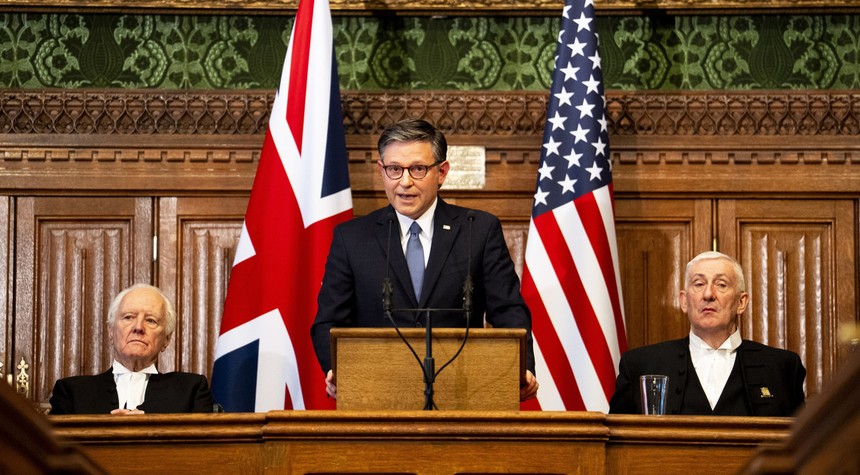
Speaker Mike Johnson stood before the British Parliament on Tuesday, becoming the first sitting House Speaker to address that body directly in the 250-year history of American independence. His mission, by his own account, was to calm troubled diplomatic waters. The irony of that task was not lost on his audience.
Even as Johnson spoke in measured tones about the enduring friendship between the United States and Britain, President Donald Trump was renewing his campaign to acquire Greenland from Denmark and criticizing what he termed Britain’s “stupidity” in relinquishing control of the Chagos Islands. The contrast between the Speaker’s warm words and the President’s sharp rhetoric underscored the complexity of America’s current relationship with its oldest allies.
Johnson, representing Louisiana’s First District, called his address a “profound honor” and described Britain as “the spiritual birthplace of our own nation.” He acknowledged that when planning the visit last fall, no one anticipated how events would unfold in recent days. The Speaker confirmed he had spoken with President Trump on Monday, telling him his mission was to encourage American friends and help stabilize the diplomatic situation.
The President’s renewed interest in Greenland, a semi-autonomous Danish territory, has sent shockwaves through European capitals. His criticism of Britain’s decision regarding the Chagos Islands, home to a joint British-American military installation, added fuel to an already combustible situation. These developments have strained relationships that both nations have long characterized as special and unbreakable.
Johnson chose not to address these specific controversies in his remarks. Instead, he emphasized shared values and historical bonds, invoking Abraham Lincoln and Winston Churchill as examples of how the two nations have evolved and strengthened together. His approach stood in marked contrast to the more confrontational style adopted by some of his colleagues in the Make America Great Again movement.
The Speaker did, however, touch on themes that align with administration criticisms of European policies. He spoke of the need for courage and conviction to defend truth, saying nations must be willing to identify what is good and enduring while calling out evil and madness. He referenced secure borders, fundamental freedoms of speech, and strong military capabilities, all subjects of recent White House commentary regarding European governance.
Lindsay Hoyle, Speaker of the British House of Commons, introduced Johnson warmly, noting their conversation the previous day. The British reception remained cordial despite the diplomatic turbulence.
Fifty years ago, then-Speaker Carl Albert received an invitation to the British Parliament to mark 200 years of American independence, though he did not address lawmakers directly. Johnson’s speech thus represents a historic milestone in the parliamentary relationship between the two democracies.
Yet history may remember this moment less for the milestone it represents than for what it reveals about the current state of transatlantic relations. The gap between Johnson’s reassuring words and Trump’s aggressive posture toward European allies suggests a fundamental tension in American foreign policy, one that no single speech, however historic, can easily resolve.
The question facing both nations now is whether the institutional friendship Johnson celebrated can withstand the pressures of an administration willing to challenge long-standing diplomatic norms. Time will tell whether calm waters can be restored or whether rougher seas lie ahead.
Related: UN Secretary General Questions American Commitment to International Norms
