
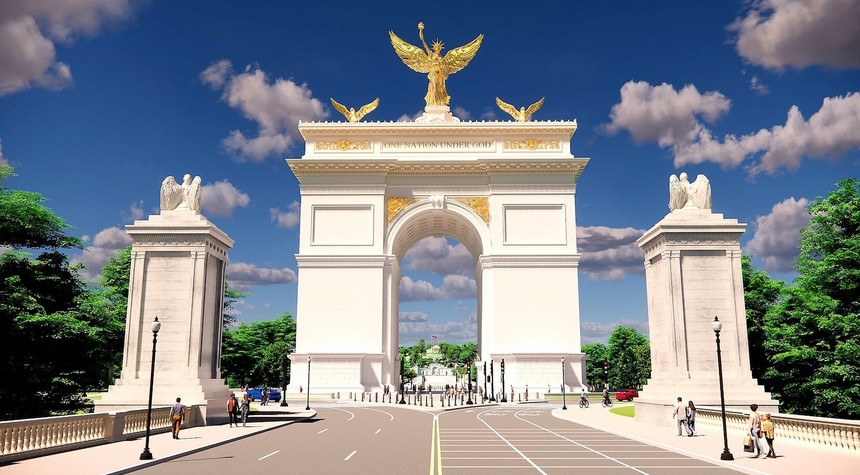
The Department of Interior has submitted final architectural plans to the National Capital Planning Commission for President Donald Trump’s proposed Triumphal Arch, setting the stage for what could be one of the most ambitious construction projects in the nation’s capital in decades.
The structure, also designated as the Monumental Arch in planning documents, would stand 250 feet tall at the foot of Arlington National Cemetery along the Potomac River on National Park Service land. The design features a golden winged statue reminiscent of the Statue of Liberty positioned atop the arch, holding aloft a torch with what planners describe as an eternal flame.
According to the National Capital Planning Commission’s project summary, the Interior Department has refined its design to ensure the flame remains visible from all angles while maintaining what officials term “visual comfort” for drivers, visitors, and the surrounding environment. The placement of this eternal flame addresses Federal Aviation Administration safety requirements following the agency’s review of the proposed structure.
The FAA determined last month that the arch would not present a hazard to aircraft operations in the area, though the agency initially indicated the structure would require red obstruction lighting for aviation safety purposes. The flame’s visibility serves to alert pilots to the structure’s presence.
Final plans reflect several modifications from earlier proposals. Traffic management adjustments include the elimination of 15 signal posts originally planned for the site, along with revised circulation routes. Environmental and historical impact assessments conducted by relevant government agencies have concluded the project would produce no significant adverse effects on these considerations.
The structure would tower over existing monuments in the capital, standing more than twice as tall as the 99-foot Lincoln Memorial and exceeding the height of France’s Arc de Triomphe. The administration has acknowledged that the arch would cause certain adverse effects on the setting and views along the Potomac River, but maintains these impacts cannot be fully avoided given that the location is central to the project’s purpose.
President Trump stated on his social media platform last month that the arch serves national security purposes at the Pentagon’s request, asserting it would function as what he termed a “top-grade Military Complex.” The Pentagon declined to provide comment on this characterization when contacted for verification.
Since the president announced the planned construction in October 2025, the project has encountered numerous legal challenges from parties opposing both its location and what they describe as negative effects on the surrounding area.
The National Park Service has outlined an aggressive construction timeline, with planning documents released earlier this year by the Interior Department indicating work would proceed 20 hours per day over a two to three year period.
The National Capital Planning Commission has scheduled a meeting for November 5 to review the final plans and consider approval of the project. This meeting represents a critical juncture for a proposal that has generated substantial debate about the appropriate use of federal land and the character of the nation’s capital.
The project’s scope and scale ensure it will remain a subject of considerable public interest as it moves through the final stages of the approval process.
Related: District Court Judge Prepares to Block Further Tree Removal at East Potomac Golf Course Site