
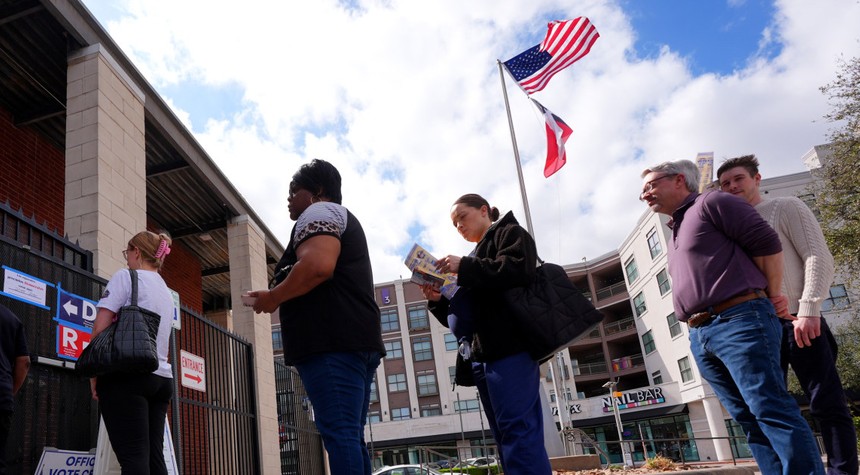
The Texas Supreme Court intervened Tuesday evening to block a lower court’s decision that would have extended polling hours in Dallas County, creating uncertainty about hundreds of ballots cast during what was meant to be additional voting time.
The state’s highest court ordered election officials to segregate all ballots cast by voters who arrived at polling locations after the standard 7 p.m. closing time. A similar ruling applied to two polling sites in Williamson County. The fate of these separated ballots remains undetermined, though they could prove consequential in closely contested races.
The evening’s confusion prompted Democratic Senate candidate Jasmine Crockett to inform supporters at her watch party that election results would not be available as anticipated.
The disruption stems from significant changes to voting procedures in both counties. Dallas County Republicans, driven by concerns about voting machine security, abandoned the countywide voting system that had been in place during recent elections. Instead, they opted for precinct-level voting, a decision that Democrats say created widespread confusion among voters accustomed to casting ballots at any location within the county.
During early voting periods, residents of both counties could visit any voting center countywide. Tuesday’s primary, however, restricted voters to party-specific precinct locations. Many voters arrived at incorrect polling sites, leading to either turned-away voters or the casting of provisional ballots.
Terri Burke, Executive Director of the Texas Democratic Party, estimated that approximately one-third of voters encountered difficulties. She attributed the problems to recent redistricting combined with the shift to precinct-based voting.
Texas operates under a system where political parties oversee their own primary elections. In recent years, Democrats and Republicans have frequently administered elections jointly, delegating operational responsibilities to county election officials. These officials had increasingly adopted countywide voting centers, allowing voters to cast ballots at whichever location proved most convenient.
Dallas and Williamson counties departed from this practice, with Republicans choosing to conduct their primaries separately at the precinct level. This decision compelled Democrats to follow suit.
The Republican Party’s motivation in Dallas County originated from skepticism regarding ballot-counting machines. Party officials initially planned to count ballots by hand, a method that election administration experts warn can introduce errors and delay results. The hand-counting plan was ultimately abandoned due to prohibitive costs, but the precinct-level voting structure remained in place.
The provisional ballots cast after 7 p.m. now sit in legal limbo following the Supreme Court’s order. Their potential impact cannot be dismissed. Dallas County serves as Crockett’s home territory and represents a crucial base of support for her campaign.
The situation underscores the practical consequences when election procedures undergo significant changes without adequate voter education. What began as an effort to address security concerns has resulted in disenfranchisement concerns of a different nature.
As Texas election officials work to resolve the status of the segregated ballots, voters and candidates alike face an extended wait for final results. The courts will ultimately determine whether the voices of those who arrived at polling places in good faith, albeit during disputed hours, will be heard in this primary election.
Related: Atlanta Hawks Face Scrutiny Over Strip Club Promotional Partnership
