
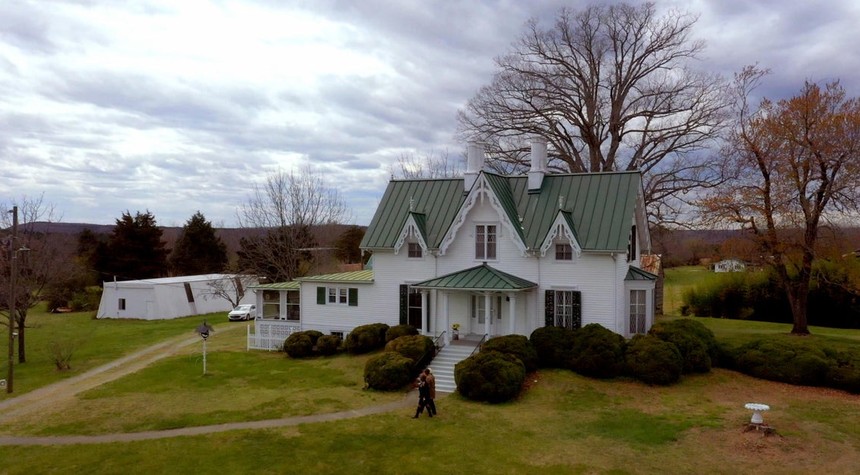
In the gentle hills of Pittsylvania County, Virginia, a grand white house called Sharswood sat silently beside the road, holding secrets from generations past. What unfolded after its purchase represents one of those remarkable American stories where history, family, and fate intersect in ways that seem almost too extraordinary to believe.
Fred Miller, a 57-year-old Air Force veteran and civil engineer, was searching for property in his Virginia hometown in 2022. Miller, who had been working in California, wanted a place large enough to accommodate his extended family’s frequent gatherings. The family is substantial. Miller’s mother and aunt were two of eleven siblings, creating a sprawling network of roughly one hundred cousins who regularly convene for birthdays, fish fries, and what family members describe as numerous cake competitions.
Miller’s sister, Karen Dixon-Rexroth, spotted the property first while driving past with their mother. She immediately contacted her brother about what she had been calling the “scary house” less than a mile from where they grew up in this quiet, rural farm country near the North Carolina border.
Pittsylvania County once produced more tobacco than any county in Virginia. The land tells stories of agriculture, hardship, and the complex history of the American South. Sharswood Manor stood as a silent witness to much of that history.
What Miller did not know when he purchased the property was that this house would lead him on an unexpected journey of discovery. The revelations that followed his acquisition proved both surprising and, in hindsight, perhaps inevitable given the deep roots his family had in the region.
The Miller family is close-knit. Fred’s cousin, Adam Miller, describes gatherings filled with games and food. His cousin Tonya Miller Pope and sister Debra Coles confirmed that family reunions are frequent affairs, necessitating considerable space. The search for a “huge place,” as Miller’s aunt Brenda put it, was essential for a family that counts its members in the hundreds.
Miller had never heard the name Sharswood before his sister’s phone call. The property was simply a practical solution to a logistical challenge. Yet this old house contained far more than rooms for relatives to gather. It contained pieces of Miller’s own family history that had been lost to time.
The discovery speaks to broader questions about American history and the stories that remain untold or forgotten. In communities across the South, properties like Sharswood hold fragments of the past that can reshape our understanding of family, place, and the connections that bind generations together, even when those connections have been obscured by the passage of time.
Miller found himself at the center of far more than a real estate transaction. What began as a search for a family gathering place became something more profound—a reconnection with history that had been waiting, patiently, for someone to uncover it.
The story of Sharswood and the Miller family reminds us that American history is not confined to textbooks or distant places. It exists in the houses along rural roads, in the land our families have walked for generations, and in the discoveries we make when we take the time to ask questions about the places we call home.
Related: Innocent Worker Fatally Shot While Conducting Inventory at Nashville Warehouse Store
