
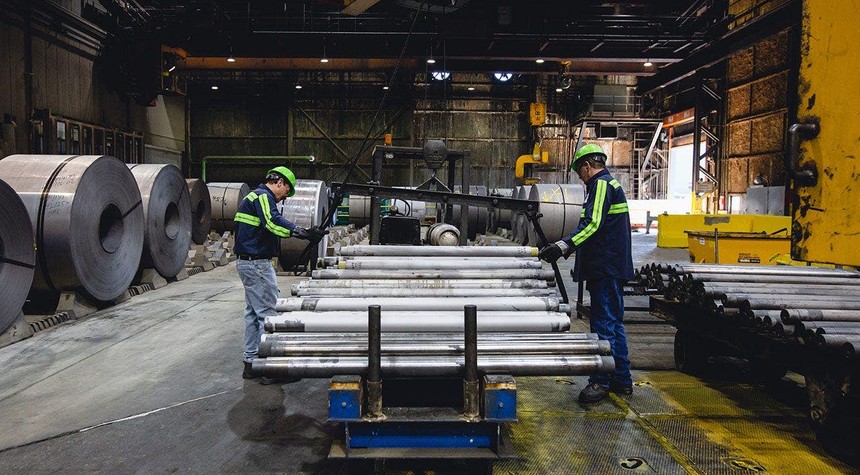
President Donald Trump will announce plans for a $15 billion steel manufacturing facility in Iowa, marking what officials describe as a significant reversal of recent industrial decline in the American heartland. Mesabi Metallics intends to construct the plant, which is projected to create more than 1,700 manufacturing positions.
The announcement comes as the Council of Economic Advisers has documented substantial gains in blue-collar employment during the current administration. According to the council’s latest economic report, the nation has added 72,000 manufacturing jobs thus far in 2026, with particular strength in durable goods sectors including metal fabrication and transportation equipment manufacturing.
These figures represent a marked departure from the final two years of the previous administration, during which the manufacturing sector shed approximately 200,000 positions. The Council of Economic Advisers, the White House agency tasked with providing economic analysis to the President, attributes the recent gains to deliberate policy choices centered on reshoring production and implementing protective tariff measures.
The administration’s One Big Beautiful Bill Act has emerged as a central pillar of this manufacturing resurgence. Among its provisions, the legislation permits manufacturers to claim an immediate 100 percent tax deduction on expenditures related to new factory construction and equipment purchases. This accelerated depreciation schedule represents a substantial departure from previous tax treatment of capital investments.
Evidence of the policy’s impact can be observed in several corporate expansions. Jergens, an Ohio-based manufacturing firm, has utilized the tax provisions to fund expansion into Illinois. Chief Executive Jack Schron reported that his employees have voluntarily increased their working hours following implementation of the legislation.
“Since the passage of the bill, our employees are voluntarily working additional hours,” Schron stated. “They are keeping more of what they earn, putting more money back into the American economy, and Jergens has a ready workforce. It is a win-win-win: a win for the employee, for Jergens and for the United States economy.”
Schron noted that 83 percent of his workforce has accepted overtime shifts, encouraged by the legislation’s elimination of taxes on overtime compensation.
In North Carolina, Ketchie Inc. has expanded its workforce by 25 percent after utilizing the full expensing provision to acquire new manufacturing equipment. According to the Council of Economic Advisers report, company officials deliberately postponed the equipment purchase until the legislation’s passage to take advantage of the favorable tax treatment.
The Iowa steel facility represents the largest such investment in American steel production capacity and arrives at a time when industrial employment has become a focal point of national economic policy. The administration has consistently emphasized manufacturing job creation as essential to rebuilding what it characterizes as a depleted industrial base.
Whether this momentum proves sustainable remains to be determined by market conditions and the longevity of the underlying policy framework. For now, however, the data suggests that American factories are once again expanding their payrolls.
That is the state of American manufacturing as we understand it this evening.
Related: Judge Halts Deportation After ICE Shooting Incident Leaves Illegal Immigrant Wounded
