
Six months ago, President Donald Trump told the American people that military operations against Iran would last four to five weeks. That projection has proven substantially off the mark, and the United States now finds itself engaged in an extended conflict that bears uncomfortable resemblance to previous Middle Eastern entanglements.
The facts are these: On February 28, American and Israeli forces launched coordinated strikes against Iranian leadership and military installations. The President justified the action as necessary to “defend the American people by eliminating imminent threats from the Iranian regime,” citing Iran’s continued pursuit of nuclear weapons capability.
That nuclear pursuit had been addressed months earlier, in June 2025, when American forces conducted Operation Midnight Hammer, striking underground Iranian nuclear facilities. The administration initially declared Iran’s nuclear program “obliterated,” though officials would later acknowledge that enriched uranium suitable for weapons production remained within Iranian territory.
The early days of the conflict were marred by tragedy. An airstrike on a girls’ school in southern Iran killed approximately 160 civilians, 120 of them schoolchildren. Neither the United States nor Israel has accepted responsibility for the attack. U.S. Central Command has stated it is investigating and emphasized that American forces will “never” deliberately target civilians. International law explicitly prohibits such targeting of educational facilities. Six months later, that investigation continues with minimal public updates.
Iran’s response was swift and substantial. The regime launched attacks on American bases across Bahrain, Kuwait, Jordan, and Iraq on a scale unseen since the Vietnam War. Utilizing missiles and inexpensive attack drones, Iranian forces demonstrated their capacity to strike vulnerable American positions throughout the Persian Gulf region.
According to U.S. Central Command, American forces have struck more than 13,000 Iranian targets, including military headquarters, naval vessels, air defense systems, and drone facilities. The exchange of fire has been persistent and costly.
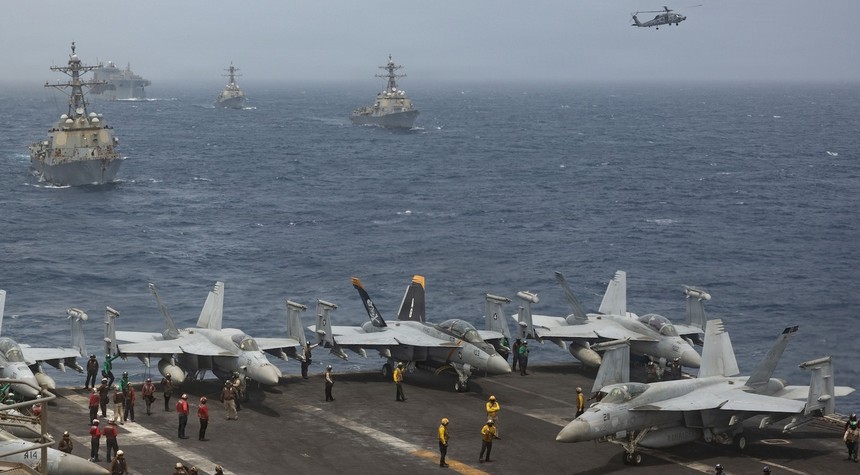
Iran’s most effective countermeasure, however, came not on land but at sea. The regime shut down commercial traffic through the Strait of Hormuz, imposing a blockade that quickly elevated the waterway to global prominence. This chokepoint, through which a significant portion of the world’s oil shipments pass, became the war’s defining frontline, rattling international markets and demonstrating Iran’s ability to dictate the terms of engagement.
In early March, Defense Secretary Pete Hegseth characterized Iran’s actions in the strait as “sheer desperation,” assuring reporters the situation was under control and required no additional concern. Six months later, the administration’s priorities have shifted noticeably. Reopening the strait and mitigating economic damage have become central objectives of the military mission.
The human cost continues to mount. Eighteen American service members have been killed since hostilities began, with more than 750 wounded in action. President Trump has attended three military funerals for fallen personnel.
The conflict that was to last a month now approaches its half-year mark with no clear resolution in sight. The American people deserve a frank assessment of what lies ahead, and when their servicemen and women might come home. That is the way it is.
Related: Canadian Tariffs Target American Paper Products as Trade Negotiations Collapse
