
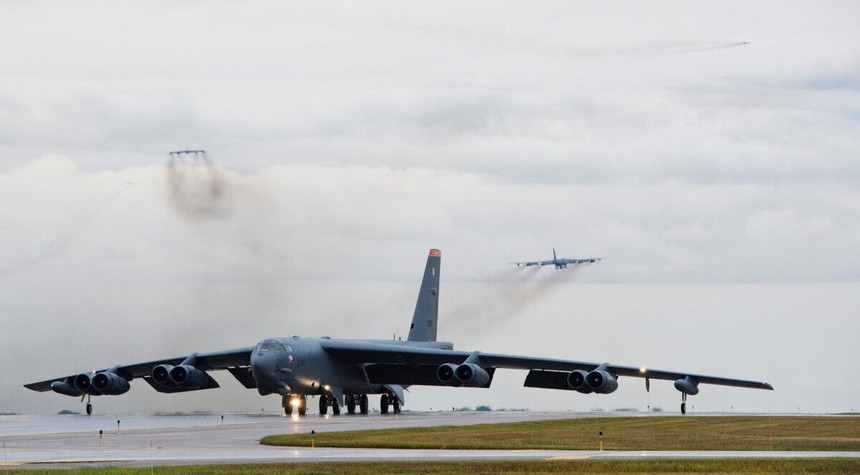
Eight Americans lost their lives Monday morning when a B-52 Stratofortress crashed immediately after takeoff at Edwards Air Force Base in California, military officials confirmed during an afternoon press conference.
The aircraft went down at approximately 11:20 a.m. Pacific time while conducting a routine test mission in support of a radar modernization program. The crash occurred entirely within the confines of the base, remaining confined to the runway area.
“Edwards Air Force Base experienced a tragedy, and we lost eight great Americans,” said Col. James Hayes, deputy commander of the 412th Test Wing, in remarks to the press. Hayes confirmed that initial indications suggest the crash was not survivable.
According to Hayes, the bomber crashed and burst into flames immediately after takeoff, leaving emergency response crews with little opportunity for rescue operations. Those crews remain on scene as officials work to account for all personnel aboard the aircraft and begin the difficult process of investigation.
The victims have not yet been publicly identified as Air Force officials continue the solemn task of notifying next of kin. Hayes revealed that the crew consisted of a mix of military personnel, government civilians, and government contractors, all supporting the test mission. This composition reflects the modern reality of military operations, where uniformed service members work alongside civilian experts in increasingly technical operations.
Officials confirmed the aircraft was not carrying any weapons at the time of the crash, a standard protocol for test missions of this nature. The B-52 was participating in a radar modernization program, part of ongoing efforts to extend the operational life of the venerable bomber fleet.
Edwards Air Force Base, located in California’s Mojave Desert approximately 100 miles north of Los Angeles, has served as a premier test facility for the Air Force since 1947. The base has been home to numerous aviation milestones and continues to play a critical role in testing and evaluating military aircraft systems.
The B-52 Stratofortress has been a cornerstone of American strategic air power for more than seven decades. First introduced in the 1950s, the bomber has undergone numerous modernization programs to keep it relevant in contemporary military operations. The Air Force has indicated plans to keep the B-52 in service well into the 2050s, making continued testing and upgrades essential to the aircraft’s mission readiness.
The crash is now under investigation, with officials working to determine the cause of this tragic accident. Such investigations typically examine all aspects of the flight, including mechanical systems, weather conditions, and operational procedures.
This incident marks one of the deadliest aviation accidents at Edwards Air Force Base in recent memory and serves as a stark reminder of the risks undertaken by those who serve in testing and developing America’s military capabilities. The loss of eight lives in service to their country underscores the dangerous nature of military aviation, even during routine operations.
Related: Fox Corporation Acquires Streaming Giant Roku for $22 Billion
