
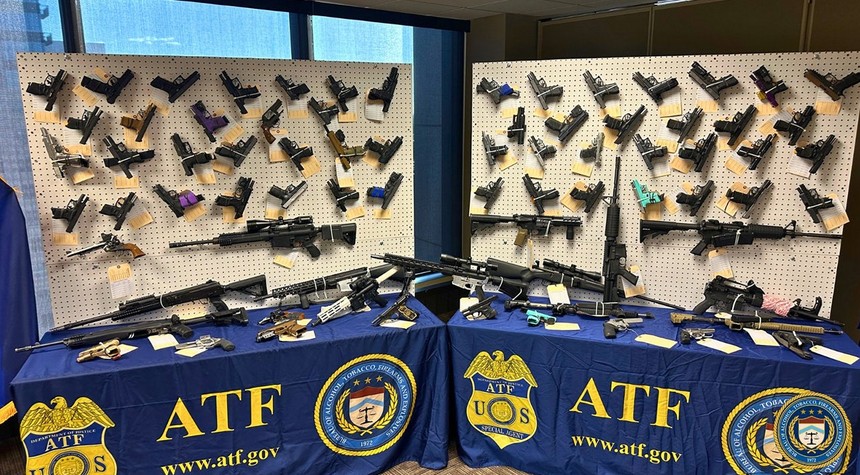
Federal agents have confiscated more than 36,000 illegal firearms since President Donald Trump returned to office, according to newly released figures from the Bureau of Alcohol, Tobacco, Firearms and Explosives. The seizures represent a significant shift in enforcement priorities under the current administration.
The ATF announced Wednesday that agents also recovered more than 2.3 million rounds of ammunition during operations targeting gang members and transnational criminal organizations. Among the seized weapons, authorities intercepted 4,359 firearms and more than 648,000 rounds of ammunition destined for Mexico, where they would have armed violent drug cartels.
ATF Deputy Director Robert Cekada emphasized the national scope of the illegal firearms problem, stating that such weapons increasingly originate from every state in the country. He characterized the situation as a national threat rather than merely a regional concern concentrated at the southwest border.
“ATF agents are aggressively targeting gangs, cartels, and transnational criminal organizations that illegally traffic firearms and turn American streets into war zones,” Cekada said in his statement.
The announcement marks a notable departure from the previous administration’s enforcement approach. Under President Biden, the ATF concentrated its efforts on regulatory matters including ghost guns and pistol braces, in addition to addressing illegal trafficking. The Trump administration has redirected the agency’s focus toward combating street crime, gang violence, and drug cartels.
This operational shift reflects broader changes in federal law enforcement priorities since the administration took office. ATF agents now employ ballistics databases, firearms tracing systems, and DNA evidence to investigate the origins of seized weapons. These investigative tools help authorities uncover supply chains and identify individuals involved in illegal trafficking operations.
The seized firearms typically follow one of two paths. Weapons with legitimate owners are returned to them, while others are eventually destroyed according to standard procedures.
The administration’s enforcement strategy has generated discussion regarding the balance between vigorous law enforcement and Second Amendment protections. White House officials have defended the approach as targeting criminal activity rather than lawful gun ownership.
Deputy Chief of Staff for Policy Stephen Miller has been vocal in criticizing state officials who decline to cooperate with federal enforcement efforts. His recent remarks focused on Illinois Governor JB Pritzker, whom Miller accused of refusing to work with the administration on crime reduction initiatives.
The ATF’s work in this area represents a fundamental component of federal law enforcement. Investigating gun trafficking and removing firearms from illegal possession serves to disrupt criminal networks that fuel violence in American communities. The agency’s use of advanced forensic technology and database systems enables agents to trace weapons through complex trafficking networks spanning multiple states and international borders.
The scale of the seizures underscores the magnitude of illegal firearms trafficking in the United States. With weapons flowing both within the country and across international boundaries, federal authorities face the challenge of disrupting sophisticated criminal enterprises while respecting constitutional protections for law-abiding citizens.
As the Trump administration continues to implement its law enforcement agenda, these figures provide concrete evidence of federal activity in the firearms trafficking arena. The coming months will reveal whether this enforcement approach yields measurable reductions in gun violence and criminal activity.
Related: Ten Backcountry Skiers Missing After Avalanche Strikes California’s Castle Peak
