
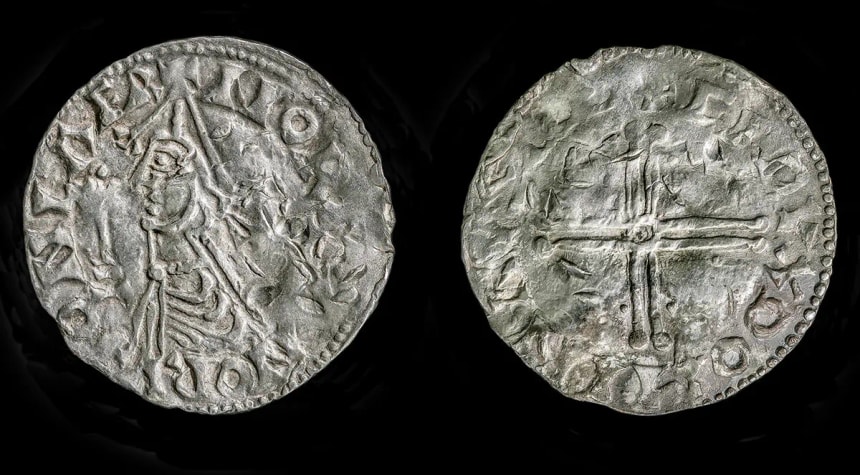
Archaeologists working in Norway have made what experts are calling a discovery of national significance: a one-thousand-year-old coin minted during the reign of Viking King Olaf Haraldsson, known to history as Saint Olaf. The coin was found within what has become the largest Viking Age coin hoard ever unearthed in Norway.
The Museum of Cultural History in Oslo announced the discovery, noting that this marks the first time a coin of this particular type has been found in Norwegian soil since 1924. The coin went on public display in late November at the Historical Museum in Oslo as the centerpiece of a new exhibition featuring the Mørstad Hoard.
The story began on April 10, when metal detectorists Vegard Sørlie and Rune Sætre made their initial discovery in Rena, located in Innlandet County. What they found proved to be far more significant than anyone initially imagined. The site has since been secured by authorities and subjected to intensive archaeological investigation.
The latest inventory places the cache at 5,500 coins, though researchers believe the final count may well exceed 6,000 pieces. Each coin must undergo extensive analysis before entering the museum’s permanent collection, involving numismatists, archaeologists, conservators, collection managers, and photographers in a meticulous documentation process.
The true prize of this remarkable find is the coin depicting Haraldsson, who ruled Norway from 1015 to 1028. This king occupies what officials describe as a unique place in Norwegian history. After his death in battle, he was canonized as a saint, cementing his legacy in both religious and national memory.
The rarity of these coins cannot be overstated. Fewer than twenty coins minted during Haraldsson’s reign have survived to the present day, and most of those have been discovered outside Norway’s borders. Only four examples of this specific type had previously been found anywhere in the world, with just one of those coming from Norway itself.
Archaeologist Anne Skogsfjord made the identification while sorting through the hoard. The coin had initially been classified as Anglo-Saxon, grouped with currency issued by Æthelred II. Upon closer examination, however, Skogsfjord noticed an inscription reading ONLAF R+ NORMANORV. The realization of what she was holding prompted her to run immediately to inform her colleagues.
The coin dates from between 1024 and 1028 and may have remained in active circulation for up to twenty-five years before being deposited in the hoard. Its design is particularly instructive about the political and religious transformations occurring in Scandinavia during this period. The coin bears a cross on both sides, a deliberate choice by Olaf to legitimize the Christian faith and establish his credentials as a Christian monarch of European standing.
Numismatics expert Svein H. Gullbekk noted the profound personal connection this artifact represents. It is entirely possible, he observed, that this very coin once passed through the king’s own hands.
Hanna Geiran, Norway’s director general of cultural heritage, emphasized the historical importance of the find. The coin represents not merely a rare object, she stated, but tangible testimony from a pivotal era when the foundations of the Norwegian kingdom were being laid and Christianity was taking root in the country.
The Mørstad Hoard represents the latest in a series of significant numismatic discoveries across Europe. Earlier this year, archaeologists in Germany uncovered eleven ancient Celtic coins at a construction site, representing the largest hoard of its kind ever found in that region and dating back more than two thousand years.
As researchers continue their painstaking work on the Norwegian hoard, the question remains whether additional surprises await discovery among the thousands of coins still being examined and catalogued.
Related: Yellowstone Villain Actor Describes Kevin Costner’s Professional Work Ethic