
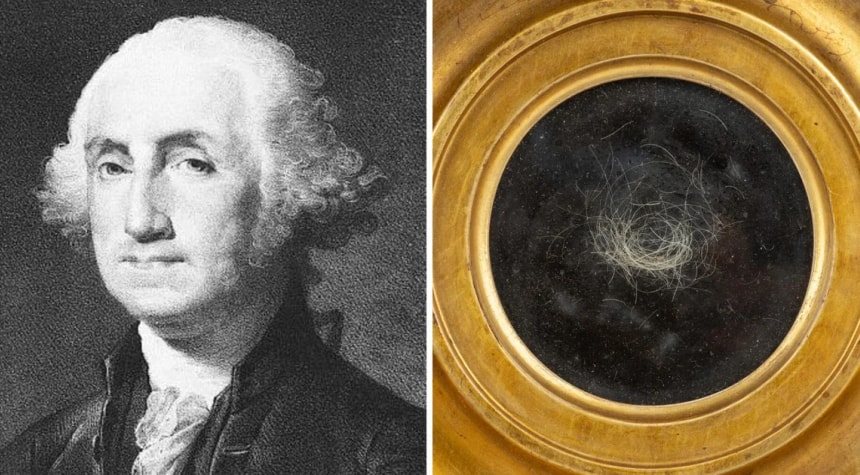
A lock of hair belonging to George Washington, the first president of the United States, was sold at auction this past Saturday for four thousand dollars by a South Carolina auction house.
The hair sample has a documented provenance tracing back to John Gadsby, a prominent hotel proprietor who entertained Washington during the final years of his life. Gadsby hosted the president’s last two birthday celebrations at his City Hotel and Tavern in Alexandria, Virginia, in 1798 and 1799. Historical records indicate that Gadsby entertained Washington for dinner shortly before the president’s death at Mount Vernon in December 1799.
Gadsby operated several prominent establishments during his career in the hospitality industry. He leased and ran the City Hotel and Tavern in Alexandria as well as the Indian Queen in Baltimore. Later in his professional life, he operated both the Franklin House and the National Hotel in the nation’s capital. Historical records suggest Gadsby was involved in the buying and selling of enslaved people to staff his hotels, though documentation from that era remains incomplete.
The lock of hair came into the possession of the auction house through the collection of John K. Lattimer, a notable collector of historical artifacts. Lattimer was a descendant of Gadsby himself.
A 1928 affidavit provided by Julia Ten Eyck McBlair, Gadsby’s granddaughter, sheds light on how the hair came into her ancestor’s possession. She stated that Gadsby obtained the lock "in view of the friendship and association with his last days." McBlair further testified that her grandfather had the hair framed and displayed it beneath a portrait of General Washington in their Washington City home, where she had observed it throughout her entire life.
The hair remains in its original presentation, housed in a nine-inch-by-two-and-a-half-inch round frame crafted from gold-gilded wood with a glass window for viewing. The auction house has not disclosed the identity of the purchaser.
This sale represents just one example of the continuing market for artifacts connected to America’s first president. In July of this year, a letter penned by Washington requesting authorization to raise the Continental Army sold for more than one hundred and nine thousand dollars. Another Washington letter, dated January 5, 1780, and addressed to Colonel Stephen Moylan in Connecticut, sold in 2024 for several thousand dollars. That correspondence concerned officer commissions within the Fourth Continental Light Dragoons, a regiment under Moylan’s command.
The market for Revolutionary War era artifacts and items connected to the founding generation continues to demonstrate robust interest from collectors and historians alike.
Related: Princeton Doctoral Student Detained by ICE at Reagan National Airport
