
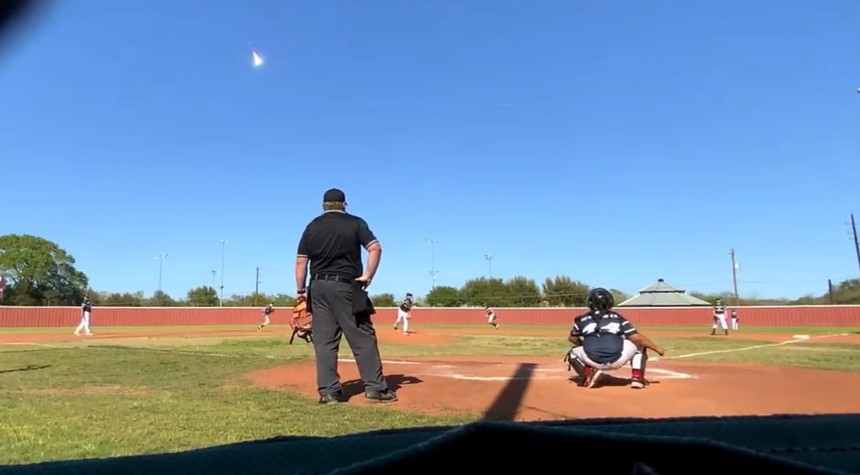
A meteor traveling at 35,000 miles per hour broke apart over the Houston area Saturday afternoon, marking the second significant meteor event in the United States within a week, NASA confirmed.
The space agency reported that the meteor event occurred at 4:40 p.m. local time, first becoming visible over Stagecoach, northwest of Houston. The object moved southeast before fragmenting 29 miles above Bammel, just west of Cypress Station.
Multiple eyewitness accounts documented the event across the greater Houston area. Video footage from doorbell cameras, automobile dashboard recorders, and even a Little League baseball game captured the fiery ball of light streaking across the clear afternoon sky.
NASA’s preliminary analysis indicates the meteor measured approximately three feet in diameter and weighed roughly one ton. As the space rock descended through Earth’s atmosphere, the resulting pressure wave generated sonic booms that residents across the region reported hearing.
The meteor’s fragmentation produced what may be the most remarkable aspect of this event. Houston-area resident Sherrie James discovered what appears to be a meteorite fragment after it crashed through the roof of her home Saturday afternoon.
James recounted that she was in her bathroom when she heard a loud boom followed by a thud emanating from her daughter’s bedroom. Upon investigation, she found a hole in the ceiling, a dent in the floor, and what she described as a large, black rock approximately the size of a baseball, though considerably heavier.
“It just looked like a rock, and rocks have no business falling out of the sky,” James stated. Fortunately, no one in the household sustained injuries during the incident, despite the startling nature of the event.
The American Meteor Society, which maintains records of fireball events worldwide, received more than 140 reports regarding Saturday’s meteor. Sightings came from across south-central and southeastern Texas, including Houston, Katy, College Station, San Antonio, and Austin.
NASA indicated that Doppler weather radar data suggests meteorites may have fallen across portions of the Houston area, particularly between Willowbrook and Northgate Crossing.
This incident follows closely on the heels of another significant meteor event. Just four days earlier, a separate daytime fireball was observed across northeastern Ohio and parts of Pennsylvania. Bill Cooke, who leads NASA’s Meteoroid Environment Office, determined that event involved a seven-ton asteroid measuring approximately six feet across.
That meteor, traveling at 45,000 miles per hour through the upper atmosphere, fragmented over Valley City, Ohio. The fragmentation released energy equivalent to 250 tons of TNT, Cooke reported, and likely produced meteorites in the vicinity of Medina County.
The occurrence of two substantial meteor events within such a brief timeframe remains noteworthy, though scientists emphasize that meteor activity occurs regularly. Most meteors burn up completely in the atmosphere without reaching the ground or causing property damage.
The fragment discovered in the James residence, if confirmed as a meteorite, would represent valuable scientific material. Meteorites provide researchers with pristine samples of material from the early solar system, offering insights into planetary formation and the composition of asteroids.
Related: Restaurant Rivalry Erupts as Chili’s Mocks Ruth’s Chris Dress Code Standards
