
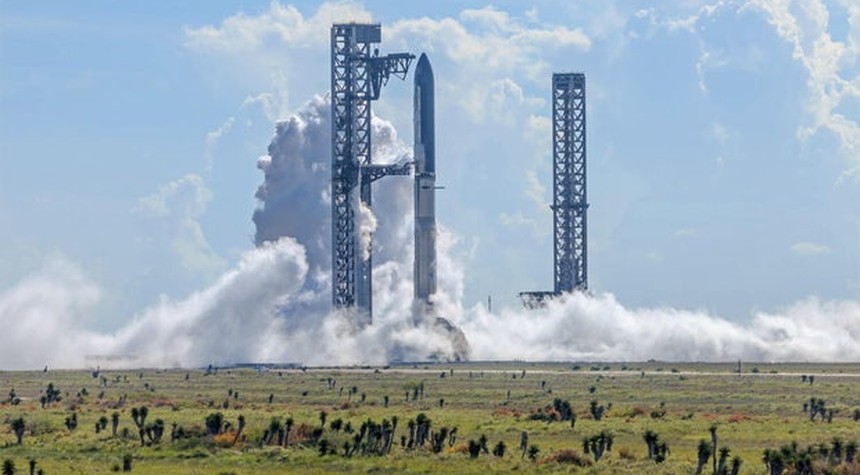
SpaceX achieved a significant milestone Monday morning when its Super Heavy-Starship system completed its first successful flight to orbit, despite encountering technical challenges that required mission controllers to cut the planned flight duration short.
The 400-foot rocket lifted off from the company’s Starbase facility on the Texas Gulf Coast at 8:49 a.m. Eastern time. The mission lasted approximately three hours before controllers brought the spacecraft down in the Pacific Ocean north of Hawaii, well ahead of the originally scheduled conclusion.
During the ascent phase, one of the six Raptor engines powering the Starship upper stage shut down prematurely as the vehicle climbed toward its initial suborbital trajectory. After careful evaluation of incoming telemetry data, flight controllers determined the spacecraft remained sufficiently healthy to continue. A second engine burn, utilizing a single Raptor engine, successfully completed the climb to orbit.
Following orbital insertion, the Starship deployed 26 third-generation Starlink internet satellites. This marked the first operational satellite deployment using the new rocket system, adding to the company’s expanding constellation in low-Earth orbit.
After the satellites separated from the vehicle, SpaceX controllers made the decision to conclude the mission early, bringing the Starship back to Earth for a controlled splashdown just before noon Eastern time.
The Super Heavy booster performed admirably during launch, with its 33 methane-burning Raptor engines generating approximately 16 million pounds of thrust. This represents twice the power output of NASA’s Space Launch System moon rocket. One engine on the booster shut down early during flight, though the system had been designed to reach space despite losing one or two engines.
Two minutes and 20 seconds after liftoff, the first stage engines began their shutdown sequence while the Starship’s six Raptor engines ignited in what is known as a “hot staging” maneuver, occurring seconds before the booster separated and began its descent.
For NASA, this successful orbital flight represents critical progress toward the agency’s Artemis program objectives. The space agency plans to utilize a variant of the Starship system for a lunar landing mission scheduled for 2028 as part of Artemis IV.
The planned lunar architecture requires multiple Super Heavy-Starship tanker flights to refuel the lander before it departs for the moon. The vehicle would then dock with a NASA Orion crew capsule in lunar orbit, retrieve two astronauts, and transport them to the lunar surface and back.
NASA Administrator Jared Isaacman congratulated SpaceX on the achievement, praising the team for managing every step in what he described as a safe, responsible, and inspirational manner. He expressed the agency’s eagerness to assist where possible and anticipation for Starship missions to become routine operations.
The prevailing expectation among industry observers is that SpaceX will ultimately achieve reliable Super Heavy-Starship operations. However, considerable uncertainty remains regarding whether the company can meet NASA’s ambitious 2028 timeline for the Artemis IV moon landing.
This mission demonstrated substantial progress in developing what is now the world’s most powerful operational rocket system. The successful orbital insertion and controlled return, despite the engine anomalies encountered during flight, provide valuable data for refining the vehicle for both commercial operations and future NASA missions.
The path forward involves numerous additional test flights to validate system reliability and demonstrate the in-orbit refueling capabilities essential for lunar missions.
Related: Team USA Rallies for Presidents Cup Victory as Trump Attends Medinah Showdown
