
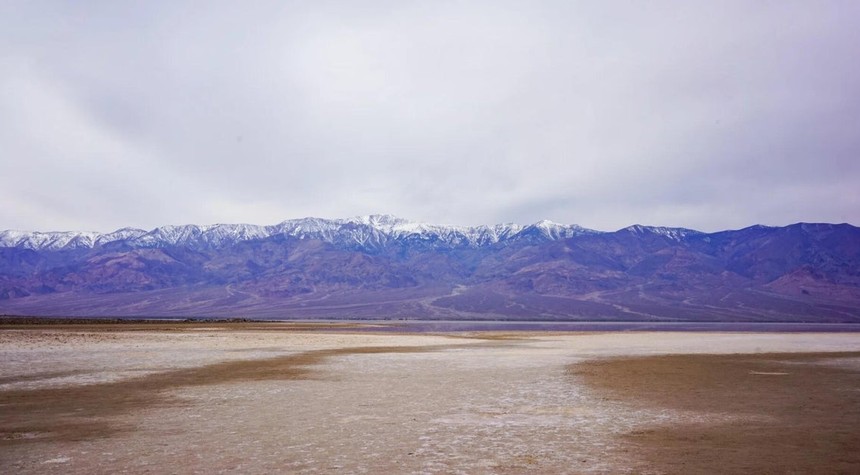
Death Valley National Park has witnessed the return of an ancient body of water that last existed during the Ice Age, following an unprecedented period of rainfall that transformed the nation’s driest landscape into a temporary lake.
The shallow lake, informally designated as Lake Manly by scientists and park officials, has formed at Badwater Basin, the lowest point in North America at 282 feet below sea level. The National Park Service reported that repeated storms between September and November delivered more precipitation to Death Valley in two months than the region typically receives in an entire year.
Rainfall measurements recorded at the park totaled 2.41 inches during the fall season, establishing this as Death Valley’s wettest autumn in recorded history, according to the National Weather Service’s Las Vegas forecast office. November alone brought 1.76 inches of rain, surpassing the previous monthly record of 1.7 inches set in 1923.
The current lake, while noteworthy, remains considerably smaller and shallower than a similar formation that appeared last year when the remnants of Hurricane Hilary passed through the valley. That event produced water levels sufficient for kayaking. The present lake’s depth would not rise above the tops of a person’s shoes in most areas, park officials noted.
Visitors can observe the phenomenon from approximately one mile from the Badwater Basin parking lot, weather permitting. Temporary closures remain in effect in some areas due to flooding conditions.
The reemergence of Lake Manly represents a remarkable glimpse into the valley’s distant past. According to NASA’s Earth Observatory, the original Lake Manly was a massive body of water that filled Death Valley between 128,000 and 186,000 years ago, during a period when ice covered the Sierra Nevada mountain range along the valley’s western boundary.
In that prehistoric era, rivers flowed from the ice-covered mountains into the valley below, creating a lake that stretched nearly 100 miles across Death Valley with depths reaching 600 feet. As the climate warmed and the ice melted, the lake gradually dried, leaving behind salt deposits that form the distinctive white flats visible at Badwater Basin today.
Modern appearances of Lake Manly occur only when exceptional rainfall covers these ancient salt flats, creating a temporary reservoir. In one of Earth’s hottest and driest environments, such events remain rare occurrences that provide scientists and visitors alike with a tangible connection to the region’s geological history.
The nearby city of Las Vegas experienced its second-wettest fall season in recorded history during the same period, underscoring the unusual weather patterns that affected the broader region.
These periodic transformations of Death Valley’s landscape serve as reminders of the dynamic nature of even the most seemingly static environments, and of the powerful forces that shaped the American West over millennia.
Related: California Man Dies After Being Served 33 Drinks on Royal Caribbean Cruise
