
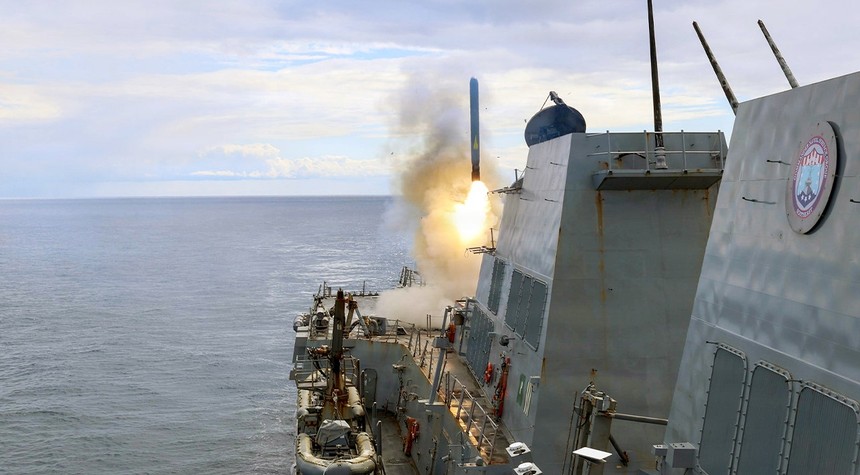
The United States Department of Defense announced Monday a substantial $22.9 billion contract with Raytheon, a division of RTX, to accelerate production of Tomahawk cruise missiles as tensions with Iran reach a critical juncture in the Strait of Hormuz.
The contract represents a significant expansion of the nation’s munitions manufacturing capacity and comes at a moment when ceasefire negotiations have reached a deadline that marks the official end of the existing U.S.-Iran agreement. The Pentagon’s move signals a clear commitment to replenishing critical long-range strike weapons that have been deployed during recent operations in the Middle East.
President Donald Trump addressed concerns about potential depletion of American weapons stockpiles in remarks made Monday, dismissing suggestions that the Iran conflict has significantly diminished the nation’s military readiness. In characteristically direct language, the President described the munitions used thus far as “peanuts,” adding that the United States maintains substantial reserves of mid-level weapons systems.
The President’s comments came as he issued a stark warning to Tehran, calling on Iran to “put up the white flag” and surrender. This uncompromising stance reflects the administration’s approach to the escalating crisis in one of the world’s most strategically vital waterways.
The Strait of Hormuz, through which approximately one-fifth of global oil supplies pass, has become a focal point of geopolitical tension. Reports from Tel Aviv indicate that regional allies are closely monitoring the situation as diplomatic channels appear to be narrowing.
The substantial investment in Tomahawk missile production addresses a concern that has been growing within defense circles. Military analysts have warned that extended operations could strain America’s weapons inventory at a time when maintaining readiness for potential challenges from other adversaries, particularly China, remains a strategic priority.
The Tomahawk cruise missile has been a cornerstone of American naval power projection for decades. These precision-guided weapons allow the United States to strike targets at considerable distances with minimal risk to American personnel. The missiles can be launched from surface ships and submarines, providing commanders with flexible options for responding to threats.
The timing of this contract award is significant. It demonstrates the administration’s determination to maintain military superiority while actively engaged in operations. Rather than allowing stockpiles to diminish, the Pentagon is moving proactively to ensure that production lines remain active and that the nation’s arsenal stays robust.
The $22.9 billion investment will likely have substantial economic implications as well, supporting thousands of jobs in the defense manufacturing sector and strengthening the industrial base that underpins American military capabilities.
As negotiations with Iran appear to have reached an impasse, the United States is positioning itself from a position of strength. The message from Washington is clear: America will maintain its military readiness and its commitment to protecting vital international waterways, regardless of the diplomatic outcome.
The coming days will prove critical as the world watches to see whether Tehran will respond to diplomatic pressure or whether the current standoff will escalate further. What remains certain is that the United States is preparing for all contingencies.
Related: Texas Gains Ground as California Companies Flee Mounting Business Expenses
