
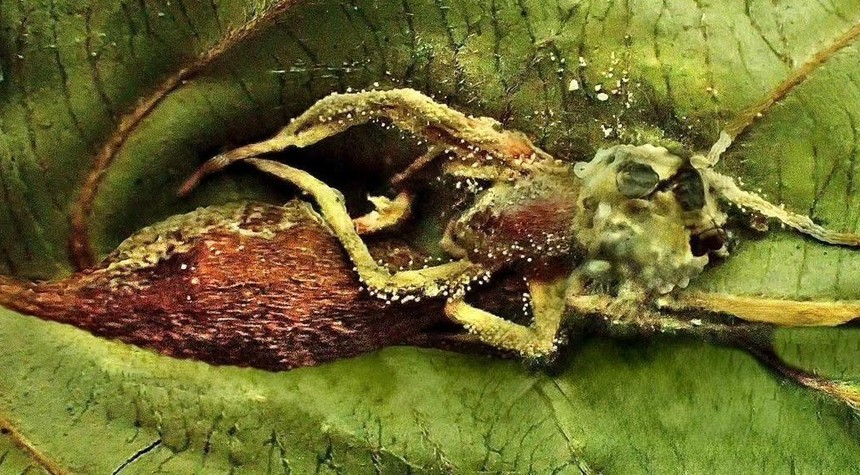
Scientists at the University of Malaysia Sabah have identified a previously unknown species of parasitic fungus that feeds exclusively on another parasitic fungus, the so-called zombie fungus known to hijack the nervous systems of insects.
The discovery was made in the Danum Valley, a remote region of Malaysia’s Sabah state on the island of Borneo. The findings were published in the New Zealand Journal of Botany and later in Phytotaxa, the leading journal in taxonomic botany.
The newly identified species, named Pleurocordyceps cornusynnemata for its distinctive horn-shaped structure, represents what scientists classify as a hyperparasite. Rather than directly attacking insects, this fungus targets another fungus that has already infected its host.
Jaya Seelan Sathiya Seelan, Deputy Director of the University of Malaysia Sabah’s Institute for Tropical Biology and Conservation, explained that the hyperparasite effectively parasitizes the primary pathogen. The zombie fungus, known scientifically as Ophiocordyceps, manipulates infected ants by controlling their nervous systems, causing erratic behavior before ultimately killing the insects and erupting from their bodies. The newly discovered Pleurocordyceps, however, infiltrates and feeds directly on the Ophiocordyceps tissue thriving inside the host ant.
The discovery came after researchers conducted multiple field expeditions to collect samples from Borneo’s biodiverse rainforests. The specimen that led to the identification was a dead ant found in the Danum Valley region.
While hyperparasites are not entirely new to science, this particular species marks the first known member of its genus to display the highly distinct horn-shaped structure that gives it its name.
During the same research expeditions, scientists also documented a new species of spider-killing fungus that spreads spores through arachnids before causing their death.
According to Seelan, these newly documented fungi hold considerable promise both as sources for developing antimicrobial drugs and as biocontrol agents against agricultural pests. The researchers emphasized that the discovery underscores the scientific value of Borneo’s rainforests, where complex ecological interactions continue to expand our understanding of life on Earth. They noted that conserving these tropical ecosystems remains critical, as countless species and ecological relationships have yet to be documented.
The mention of zombie fungus may conjure fears popularized by entertainment media, but experts maintain that humans face no threat from cordyceps fungi. Dr. Jim Kronstad, a microbiologist at the University of British Columbia, has stated that it is not possible for cordyceps fungi to adapt from infecting insects to humans. The human body’s temperature and immune system prevent most fungal species from surviving, as they cannot withstand temperatures beyond 98.6 degrees Fahrenheit.
The research represents another chapter in the ongoing scientific exploration of one of the world’s most biodiverse regions, where the complexity of nature continues to reveal itself to those willing to venture into its depths.
Related: Questions Mount Over $397 Million Transfer to White House Security Fund
