
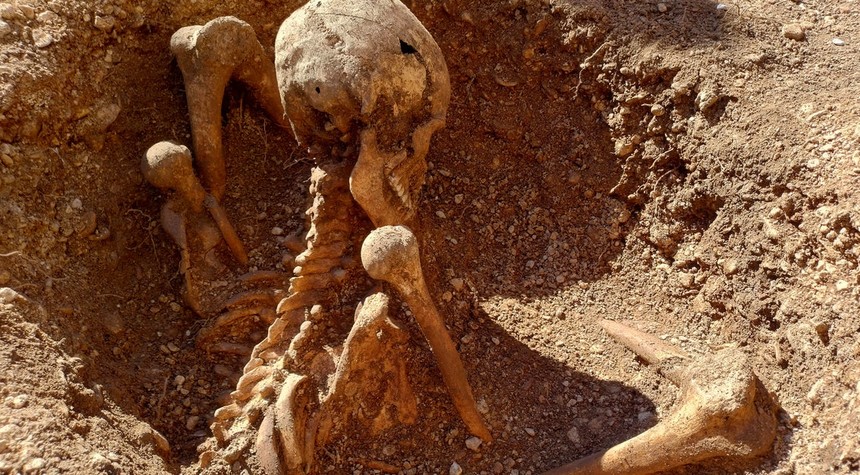
French archaeologists have discovered another remarkably preserved skeleton buried in an unusual seated position near a primary school in Dijon, marking the fifth such find this month and raising new questions about ancient Gallic burial practices.
The skeleton, found adjacent to the Josephine Baker primary school in eastern France, sits upright at the bottom of a circular pit approximately one meter in width. Its hands rest in its lap, and like the four similar discoveries made earlier this month, the remains face westward with the back positioned against the eastern wall of the burial site.
The discovery adds to a growing collection of mysterious burials that have emerged from this construction site. Last year, researchers from the French National Institute for Preventive Archaeological Research unearthed thirteen additional Gallic skeletons roughly twenty meters from the current location. All the remains are believed to date from approximately 300 to 200 BC, a period when the Gaul civilization held significant presence across what is now modern France.
What makes these discoveries particularly intriguing to researchers is not merely the unusual burial position, but the evidence of violence found on several of the skeletons. Last year’s findings revealed unhealed marks of violence on some remains, which archaeologists believe indicate intentional killing. One skeleton bore two distinct blows to the skull from what appears to have been a sharp weapon, possibly a sword.
The question that now confronts scientists is why the Gauls chose to bury certain individuals in this distinctive seated position facing west, and whether these men were alive when placed in their graves. The answers remain elusive, largely because so little is known about Gallic culture beyond what was recorded by their contemporaries and conquerors.
The Gauls emerged as a distinct Celtic group around the fifth century BC, eventually spreading across territories that encompass modern-day France, Belgium, Switzerland, and regions farther east. Despite their significant historical presence, much of what we know about their civilization comes from external sources, many of which carry inherent biases. The Roman emperor Julius Caesar, who conquered the Gauls in 50 BC, left written accounts, but historians must approach such records with caution given the political motivations of a conquering force.
Archaeological work conducted over the past three decades has revealed that Dijon held particular significance for the Gallic people, though the exact nature of that importance continues to be investigated. Each new discovery provides another piece of a complex puzzle that may eventually shed light on the religious beliefs, social structures, and cultural practices of this enigmatic civilization.
The latest find, with its exceptional state of preservation, may offer researchers new opportunities to understand not only the burial practices but also the daily lives and deaths of these ancient people. As excavation work continues at the construction site, archaeologists remain hopeful that additional discoveries will help answer the many questions surrounding these mysterious seated burials and the civilization that created them.
Related: Generational Divide Emerges in Maine Democratic Race to Challenge Collins
