Kansas City Chiefs quarterback Patrick Mahomes demonstrated remarkable resilience Sunday afternoon, returning to action after sustaining what initially appeared to be a significant injury to his throwing arm during a game against the New York Jets.
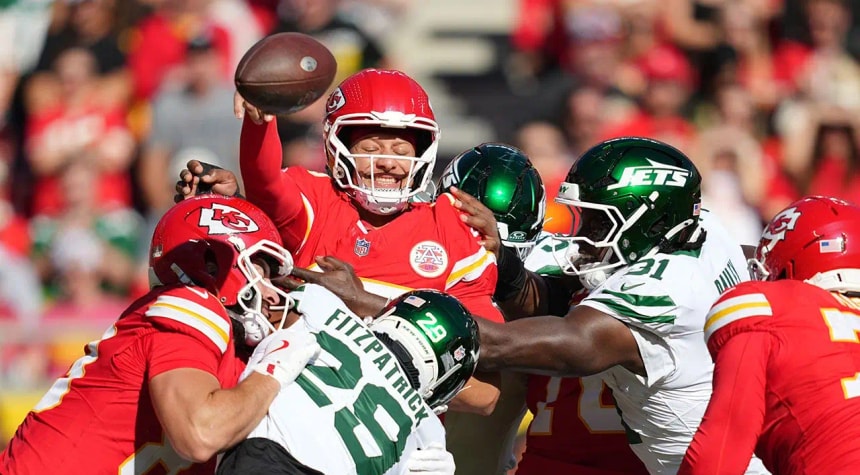
The injury occurred when Jets edge rusher David Bailey struck Mahomes as the quarterback was preparing to release a deep pass. The collision caused Mahomes’ throwing arm to make contact with Bailey, resulting in an incomplete pass that was ruled a fumble on the field. Mahomes immediately dropped to his knees, clutching his right elbow in visible distress.
The scene prompted immediate concern among coaches, teammates, and observers. For several moments, it appeared the Chiefs might lose their franchise quarterback for an extended period. Elbow injuries to throwing arms have proven devastating to quarterbacks in recent years, with such injuries often requiring extensive rehabilitation or even surgical intervention.
However, Mahomes returned to the field on Kansas City’s subsequent offensive series. Though he appeared to favor the injured arm while warming up on the sideline, the quarterback completed a pass to tight end Travis Kelce upon returning, then rushed for a seven-yard gain on a scramble up the middle.
Following halftime, during which team medical staff almost certainly conducted additional evaluation of the elbow, Mahomes returned once again. He proceeded to lead the Chiefs on a touchdown drive that extended Kansas City’s advantage to 21-12.
Medical experts observing the game noted that Mahomes’ ability to continue playing strongly suggests he avoided a UCL tear. Such an injury would likely have prevented him from throwing the football with any degree of effectiveness or accuracy. The UCL, or ulnar collateral ligament, is critical for throwing mechanics. A tear to this ligament famously sidelined San Francisco 49ers quarterback Brock Purdy during a playoff game several seasons ago, effectively ending his participation in that contest.
The incident adds another chapter to Mahomes’ growing reputation for durability and toughness. The quarterback has previously demonstrated an ability to play through various injuries, maintaining his high level of performance even when dealing with physical setbacks that might sideline other players.
The Chiefs’ medical staff will undoubtedly continue monitoring Mahomes’ condition in the coming days. Further evaluation and imaging may provide additional clarity regarding the extent of the injury and any potential long-term concerns.
For now, Kansas City can take comfort in the fact that their quarterback finished the game and appears to have avoided serious structural damage to his throwing arm. The victory keeps the Chiefs in strong position as the season progresses, and Mahomes’ durability once again proves vital to the team’s championship aspirations.
Related: High School Soccer Coach Barred From Playoff Game After 100th Win Celebration