
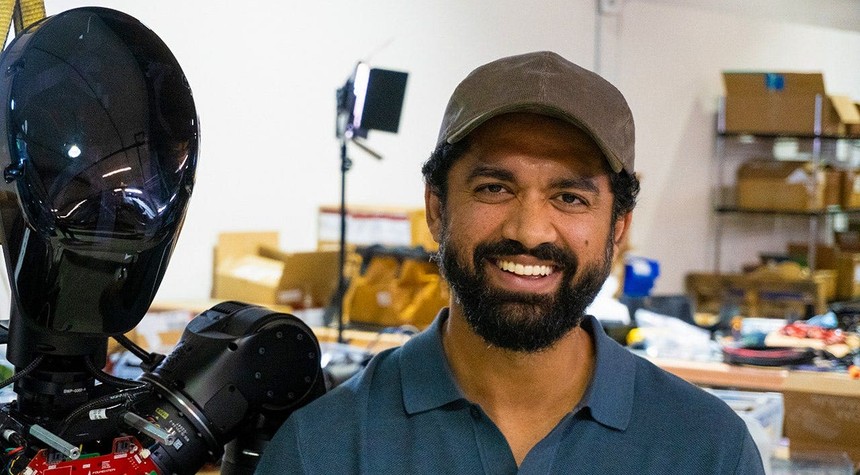
The prospect of humanoid robots patrolling America’s southern border has moved from science fiction to serious consideration, as a U.S. robotics company reports it has demonstrated the technology to Department of Homeland Security officials.
Sankaet Pathak, founder and CEO of Foundation, a robotics company, disclosed that his firm has engaged in discussions with multiple national security agencies regarding the deployment of autonomous humanoid robots capable of navigating difficult terrain and detecting human presence along the border.
“We’re in conversations with almost all national security government bodies, so Air Force, Navy, Army, DHS,” Pathak stated. “We continue to have dialogues. We’re starting to negotiate contracts and some applications for them.”
The company’s Phantom robot represents what Pathak describes as a solution to gaps in current border security infrastructure. While drones and fixed surveillance towers have become standard tools for border monitoring, Pathak argues these technologies have inherent limitations.
“If drones and watchtowers were able to solve for everything, why do we still have humans at the border?” Pathak asked, pointing to the challenges of logistics and navigating complex terrain that existing automated solutions struggle to address.
According to Pathak, the Phantom robot possesses the capability to distinguish humans from other obstacles, autonomously traverse uneven terrain, and map its environment. The company envisions these robots conducting reconnaissance and surveillance operations in areas that prove difficult for human agents, vehicles, aerial drones, or fixed cameras to monitor effectively.
The operational concept calls for robots to function autonomously, flagging potential border crossings for human officers rather than replacing border agents entirely. Pathak emphasized the goal of keeping officers safe while maintaining continuous surveillance capabilities.
“Our biggest thing is if we can keep our officers in a safe place, and these robots can continue to surveil 24/7,” he explained. The robots would alert human personnel to significant activity, allowing officers to respond when intervention becomes necessary.
Foundation has also identified border tunnels as another potential application for the technology, with plans to explore underground operations as part of future use cases.
A Department of Homeland Security spokesperson clarified the current status of any relationship with Foundation, stating that “The Department of Homeland Security currently does not have any non-contractual agreements, pilots, or active prime contracts with Foundation.”
Nevertheless, Pathak expressed confidence in the technology’s readiness for deployment. “Tomorrow I think we could do a pilot. Next couple of months, we can do something much larger,” he said.
The company plans to release a more rugged version of the Phantom robot in the coming months, featuring waterproof and dustproof capabilities designed to withstand harsh border environments. Pathak acknowledged that weather resistance remains one of the principal limitations of the current technology.
The development comes at a time when border security remains a central concern for many Americans, particularly those who prioritize enforcement of immigration laws and protection of national sovereignty. Whether humanoid robots will ultimately join the ranks of border patrol agents remains to be determined, but the technology appears to be advancing toward that possibility.
Related: NYPD Officers Fatally Shoot Armed Man in Lower East Side Apartment Building
