
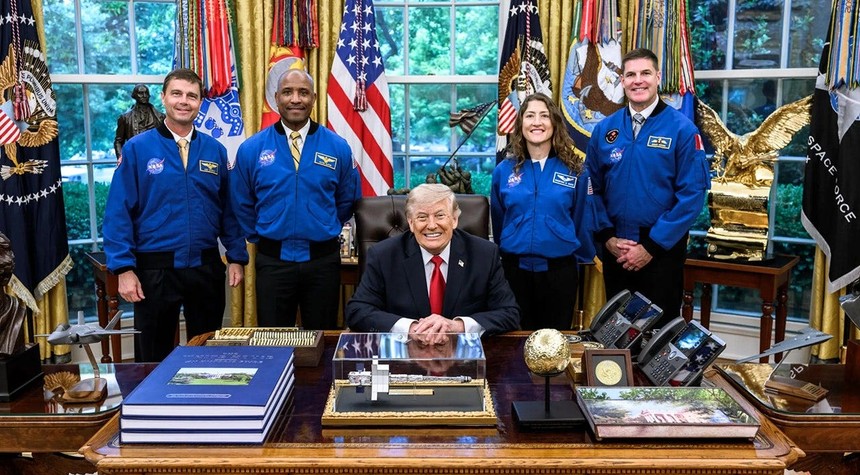
President Donald Trump will award the Congressional Space Medal of Honor to four astronauts who traveled farther from Earth than any humans in history during their mission around the moon earlier this year.
The ceremony, scheduled for August 28 at NASA’s Johnson Space Center in Houston, will honor NASA astronauts Reid Wiseman, Victor Glover, and Christina Koch, along with Canadian Space Agency astronaut Jeremy Hansen. The four crew members made history in April aboard Artemis II, marking the first crewed flight of NASA’s Orion spacecraft and the first mission to carry astronauts around the moon in more than fifty years.
The significance of this achievement cannot be overstated. At their farthest point from home, the crew traveled 252,756 miles from Earth, surpassing the human spaceflight distance record established by Apollo 13 in 1970. Over the course of their nearly ten-day mission, the astronauts covered a total distance of 695,081 miles.
The voyage began on April 1, when NASA’s Space Launch System rocket lifted off from Kennedy Space Center in Florida, generating 8.8 million pounds of thrust. After conducting critical tests of Orion’s systems in space, the crew set course for the moon. On April 6, they passed within 4,067 miles of the lunar surface during a historic flyby.
Throughout their journey, the astronauts documented their experience extensively, capturing more than 7,000 images. These photographs included spectacular views of earthrise and earthset, detailed imagery of lunar craters and ancient lava flows, and a solar eclipse observed from their unique vantage point aboard Orion. The crew also reported witnessing meteoroid impact flashes on the moon’s dark side, providing valuable scientific observations.
The mission concluded on April 10 when Orion reentered Earth’s atmosphere at approximately 25,000 miles per hour before splashing down in the Pacific Ocean off the coast of California. The successful return demonstrated the spacecraft’s capability to protect its crew during the extreme conditions of reentry from deep space.
NASA Administrator Jared Isaacman acknowledged after the crew’s return that the astronauts had accepted significant risk while testing the spacecraft and systems designed to carry future crews deeper into space. NASA astronaut Matthew Dominick has emphasized that this mission represents a crucial step toward future interplanetary journeys, with the agency targeting establishment of a permanent lunar base by 2028.
The Artemis II mission represents more than a single achievement. It signals America’s renewed commitment to human space exploration and demonstrates the technical capabilities necessary for sustained operations beyond low Earth orbit. The data gathered and systems tested during this mission will prove invaluable as NASA continues its efforts to return humans to the lunar surface and eventually venture to Mars.
The Congressional Space Medal of Honor, one of the nation’s highest civilian honors, recognizes astronauts who have demonstrated exceptional courage and made significant contributions to space exploration. The upcoming ceremony will mark a moment of national recognition for these four individuals who pushed the boundaries of human achievement and advanced our understanding of what is possible in the realm of space exploration.
Related: Fentanyl Deaths Drop 22 Percent as Border Security Measures Take Effect
