
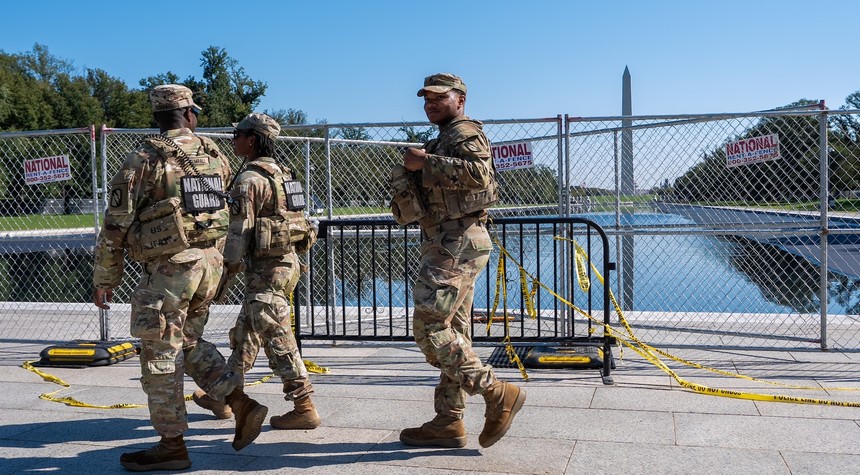
More than fourteen months after National Guard members first began patrolling the streets of Washington, a federal appeals court is now deliberating whether their presence in the nation’s capital remains lawful.
The U.S. Court of Appeals for the District of Columbia Circuit heard oral arguments Wednesday in a case that strikes at the constitutional heart of federal authority over the nation’s capital. At issue is whether President Donald Trump possessed the legal authority to deploy thousands of troops to city streets in what his administration characterized as a crime-fighting operation.
The deployment commenced in August 2025, eventually reaching a peak force of approximately 5,000 troops over the summer months. These service members have supported arrest operations, patrolled neighborhoods throughout the city, and participated in various cleanup efforts.
The Trump administration maintains that the deployment has contributed to declining crime rates in the District, though officials acknowledge that crime statistics were already trending downward before the National Guard arrived. Administration attorneys argue that the president’s constitutional role as commander in chief, combined with Congress’s authority over the federal district, provides ample legal foundation for the deployment.
District officials and local activists present a starkly different assessment. They contend the prolonged military presence represents an unprecedented normalization of domestic militarization and constitutes an inefficient use of taxpayer resources. The District’s attorney general brought the case, arguing that the mobilization violates prohibitions against using military forces for domestic law enforcement.
The constitutional question centers on the unique status of Washington as a federal district rather than a state. While the Constitution grants Congress authority over the District of Columbia, the Home Rule Act of 1973 established limited self-governance, allowing residents to elect a mayor, council members, and neighborhood commissioners.
The case has already progressed through multiple legal stages. Last December, the three-judge appellate panel issued a unanimous thirty-two-page ruling that paused a lower court decision declaring the deployment illegal. That ruling suggested Trump might ultimately prevail, noting that the president “possesses a unique power” to mobilize forces in Washington.
The panel’s decision identified several factors favoring the administration’s position, including concerns about disrupting the lives of thousands of service members and the president’s interest in protecting federal governmental functions and property within the capital. Notably, the judges determined that the District “has not identified any ongoing injury to its statutory interests.”
Legal experts analyzing the case suggest the District faces considerable obstacles. Syracuse law professor William Banks indicated that outside of arguments grounded in the Home Rule Act, “there is no overarching federal principle that would bail out the district in this case.” The District’s lack of statehood, combined with presidential authority as commander in chief, creates what Banks described as “tremendous amount of leeway and discretion” for the executive branch.
Should the District prevail at the appeals court level, the Trump administration is expected to seek review from the Supreme Court, which has demonstrated considerable deference to presidential authority in recent decisions.
The outcome will establish important precedent regarding the balance between federal authority and local governance in the nation’s capital, with implications that extend beyond this particular deployment.
Related: Treasury Report Confirms Major Banks Denied Services Based on Political and Religious Views
