
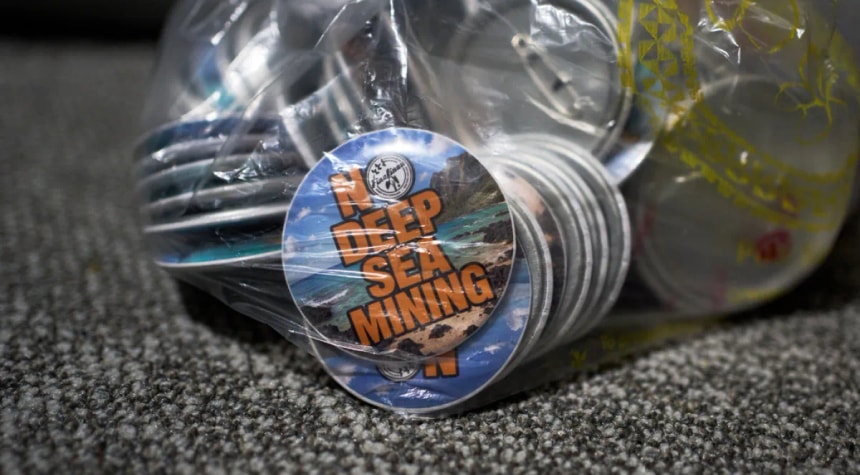
The Trump administration has completed the sale of two deep-sea mining leases encompassing nearly 32 million acres off the coast of American Samoa, marking the first such auction in United States history. The lease sale proceeded Thursday despite ongoing legal challenges from environmental organizations.
The Marine Minerals Administration conducted the auction with participation from Adepth Minerals Inc. and Wetstone US Ventures, generating $6 million in total bids. Acting MMA Director Mike Olsen defended the sale by emphasizing the strategic importance of securing domestic access to critical minerals essential for modern electronics, clean energy technologies, and national defense applications.
The leases authorize preliminary exploration activities including mapping and testing of the ocean floor. The administration maintains that any future development would be subject to rigorous federal safety and environmental standards.
The targeted waters contain polymetallic nodules, potato-sized rock formations resting on the sea floor that may hold significant deposits of cobalt, copper, iron, manganese, and nickel. These minerals have become increasingly vital to American manufacturing and technology sectors, with current supply chains heavily dependent on foreign sources, particularly China.
The lease sale represents a component of the administration’s broader strategy to strengthen domestic critical-mineral production capabilities. Officials have noted that reliable access to these resources would help American manufacturers maintain operations during supply chain disruptions. The Marine Minerals Administration has indicated interest in expanding the program to waters near the Northern Mariana Islands, Guam, Alaska, and Virginia.
The auction faces immediate legal complications. A federal court in Hawaii ruled earlier this week that the National Marine Fisheries Service violated the Endangered Species Act in its approval process for the lease sale. The court determined that the environmental review examined only the preliminary effects of issuing the leases themselves and failed to account for potential impacts from subsequent mining operations. Notably, the ruling did not vacate or halt the lease sale.
The legal challenge was initiated in August by Faʻasao Amerika Samoa and the Conservation Council for Hawaii, with representation from the environmental advocacy organization Earthjustice. The plaintiffs argue that deep-sea mining operations would destroy marine habitats and cause widespread water pollution in pristine ocean environments.
Jonee Peters, executive director of the Conservation Council for Hawaii, characterized the court decision as confirmation that marine ecosystem protection must take precedence over what she described as speculative industrial ventures. Environmental groups have expressed determination to continue their legal opposition to the program.
The administration’s push for domestic mineral production reflects growing concerns about national security vulnerabilities created by reliance on foreign suppliers, particularly as tensions with China have increased. Critical minerals are integral to defense systems, renewable energy infrastructure, and consumer electronics manufacturing. The question now centers on whether the economic and strategic benefits of domestic deep-sea mining can be reconciled with environmental preservation concerns through the federal regulatory process.
Related: Coin Toss Decides Florida Commissioner Race Following Multiple Recounts
